
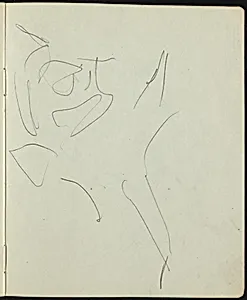
Dancers and Performers (Page from a Sketchbook)
c. 1911
Medium
graphite on wove paper
Dimensions
overall: 16.5 x 20.4 cm (6 1/2 x 8 1/16 in.)
Classification
Drawing
Department
CG-W
Museum
National Gallery of Art, Washington, D.C.
Credit
Ailsa Mellon Bruce Fund
Accession Number
2002.99.1.6
Rights
Public Domain
Art Historical Context
Ernst Ludwig Kirchner, founding member of the German Expression group Die Brücke, the vibrant energy of urban nightlife in *Dancers and Performers a page from his sketchbook dated around 1911. Active in Dresden and later Berlin, Kirchner drew inspiration from the cabaret culture and street performers of the early 20th century, the group's rejection of traditional academic art in favor of raw emotional expression. This intimate drawing, executed in graphite on wove paper exemplifies his fascination with movement and the human form amid the social upheavals of pre-World War I Germany. The artwork's small scale—measuring just 16.5 x 20.4 cm—highlights its origin as a spontaneous sketch, likely made on the go to seize fleeting moments. Kirchner's dynamic, angular lines and expressive distortions convey the rhythm and ecstasy of dance, hallmarks of Expressionism even in monochrome. Wove paper's smooth texture allowed for precise shading and fluid strokes, building depth and vitality in this preparatory study. Housed in the National Gallery of Art through the Ailsa Mellon Bruce Fund, this piece offers a window into Kirchner's creative process, bridging his bold paintings and prints. It invites visitors to appreciate how such sketches fueled the revolutionary spirit of modern art.
About the Artist
Ernst Ludwig Kirchner · 1880–1938
Ernst Ludwig Kirchner was born on May 6, 1880, in Aschaffenburg, Germany, to parents Ernst and Maria Kirchner, part of a family of Prussian descent that frequently relocated due to his father's career as a chemical technician. After early schooling in various towns, he studied architecture at the Königliche Technische Hochschule (Technical University) in Dresden from 1901 to 1905, taking courses i...