Ctrl K
1880–1938
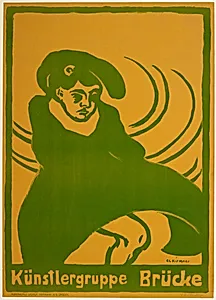
Ernst Ludwig Kirchner was born on May 6, 1880, in Aschaffenburg, Germany, to parents Ernst and Maria Kirchner, part of a family of Prussian descent that frequently relocated due to his father's career as a chemical technician. After early schooling in various towns, he studied architecture at the Königliche Technische Hochschule (Technical University) in Dresden from 1901 to 1905, taking courses in freehand drawing, perspective, and art history, which provided foundational artistic training. There, he formed close bonds with fellow students Fritz Bleyl, Erich Heckel, and Karl Schmidt-Rottluff, sharing a radical vision that led them to found the Die Brücke artists' group in 1905. Rejecting academic traditions, Die Brücke sought to bridge past and present through primal, direct expression, reviving woodcuts and emphasizing life drawing from nude models in natural settings.
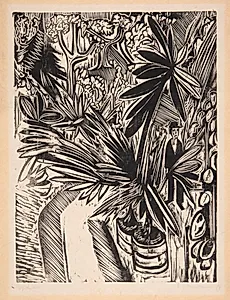
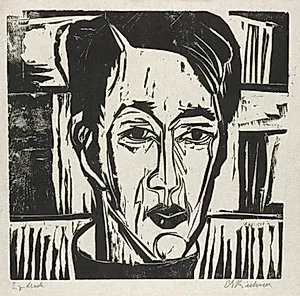
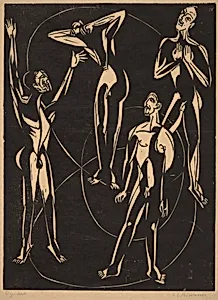
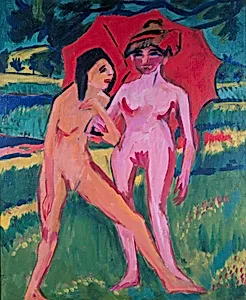
Kirchner worked in the Die Brücke tradition of German Expressionism, characterized by jagged lines, distorted forms, vibrant unnatural colors, and psychological intensity, drawing from influences like Albrecht Dürer, Edvard Munch, Fauvism, and Oceanic art. Relocating to Berlin in 1911 with the group, he captured the city's alienation in street scenes featuring prostitutes and angular urban chaos, as in *Street, Berlin* (1913, oil on canvas) and *Nollendorfplatz* (1912). Other key works from this era include *Marzella* (1909–1910), a provocative nude, and innovative woodcuts like *Nude Dancers* (1909). He briefly co-founded the MIUM-Institut art school with Max Pechstein, though it failed commercially.
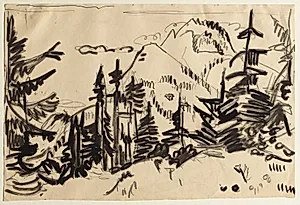
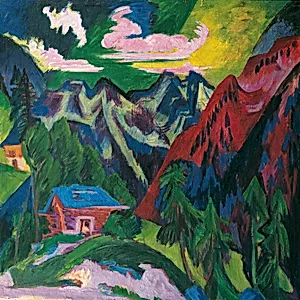
World War I shattered Kirchner; he volunteered in 1914 but suffered a breakdown by 1915, depicted in *Self-Portrait as a Soldier* (1915), leading to discharge and sanatorium stays for depression and addictions. Settling in Davos, Switzerland, from 1917, he produced luminous Alpine landscapes like *Sertig Valley in Autumn* (1925) and *Archers* (1935–1937), reflecting recovery and harmony with nature. Long-term partner Erna Schilling supported him amid Nazi persecution—639 works confiscated as "degenerate" in 1937—culminating in his suicide by gunshot on June 15, 1938. Kirchner's legacy endures as a cornerstone of Expressionism, his dynamic woodcuts and emotive visions profoundly shaping modern art's raw emotional power.
![Dancing Couple in the Snow [reverse]](https://images.artheonmuseum.org/nga/thumb/dancing-couple-in-the-snow-reverse-nga-163768.webp)
![Dance Hall Bellevue [obverse]](https://images.artheonmuseum.org/nga/thumb/dance-hall-bellevue-obverse-nga-71238.webp)
![Nude Figure [reverse]](https://images.artheonmuseum.org/nga/thumb/nude-figure-reverse-nga-57459.webp)
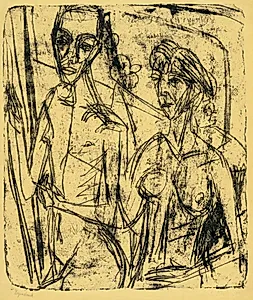
![Two Nudes [obverse]](https://images.artheonmuseum.org/nga/thumb/two-nudes-obverse-nga-57458.webp)