
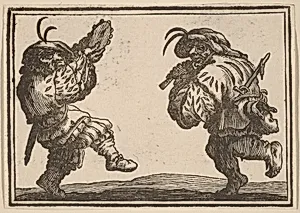
Dancers with Flute and Tambourine
Medium
woodcut on laid paper
Dimensions
sheet (trimmed to block): 6 × 8.3 cm (2 3/8 × 3 1/4 in.)
Classification
Department
CG-E
Museum
National Gallery of Art, Washington, D.C.
Credit
R.L. Baumfeld Collection
Accession Number
1969.15.227
Rights
Public Domain
Art Historical Context
Step into the lively world of 17th European festivities with *Dancers with Flute Tambourine*, a woodcut on laid paper created in 1621 by Edouard Eckman after the renowned French printmaker Jacques Callot. This petite print, measuring just 6 ×8.3 cm, captures musicians and dancers in exuberant motion—flutes trilling and tambourines rattling amid swirling skirts and dynamic poses. Callot, a master of Baroque printmaking, was celebrated for his intricate depictions of commedia dell'arte performers, gypsy encampments, and carnivalesque scenes, drawing from Italian theatrical traditions that enchanted courts across Europe. The woodcut medium, a relief printing technique carved into wood blocks, allowed for affordable reproduction of Callot's highly detailed etchings, making his vivid narratives accessible beyond elite collectors. Produced on laid paper—a hallmark of early modern printmaking—this work likely belongs to one of Callot's famous dance series, such as *Balli di Sfessania*, evoking the joyful chaos of public balls and street performances during the early Baroque era. Its trimmed sheet reflects the intimate scale of album collections, prized for their portability and repeated viewing. Housed in the National Gallery of Art's R.L. Baumfeld Collection (Department CG-E), this print exemplifies how Callot's innovative style influenced generations of artists, blending realism with theatrical flair to immortalize fleeting moments of human revelry. A tiny window into a boisterous past!
About the Artist
Edouard Eckman after Jacques Callot
Edouard Eckman, a Flemish printmaker born around 1600, remains a somewhat enigmatic figure in art history, with his early life not well documented. Little is known about his training or formal education, though his oeuvre suggests familiarity with the vibrant printmaking traditions of the early Baroque period in Northern Europe. Active primarily in the second decade of the seventeenth century, Eck...