
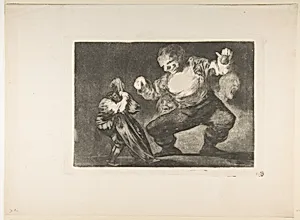
'Dancing Giant' from the 'Disparates' (Follies / Irrationalities)
ca. 1815–19 (published between 1854–63)
Medium
Etching, burnished aquatint, drypoint
Dimensions
Plate: 9 5/8 × 13 3/4 in. (24.5 × 35 cm) Sheet: 14 5/8 × 19 15/16 in. (37.2 × 50.6 cm)
Classification
Prints
Department
Drawings and Prints
Museum
Metropolitan Museum of Art, New York, NY
Credit
Rogers Fund, 1921
Accession Number
21.54.1
Rights
Public Domain
Tags
Art Historical Context
Francisco de Goya’s “Dancing Giant,” created around 1815–19, belongs to his enigmatic “Disparates” (Follies) series. This late body of work explores the irrational forces that shape human behavior, blending the grotesque with the sublime. The towering central figure, surrounded by smaller men who appear both compelled and terrified, embodies the series’ fascination with fear and collective folly. Though never published in Goya’s lifetime, the prints were issued decades later, allowing later generations to confront their haunting vision of unreason. Goya rendered the scene through etching, burnished aquatint, and drypoint, techniques that let him achieve velvety shadows and flickering highlights. The burnished aquatint produces broad areas of darkness that swallow parts of the giant’s form, while drypoint scratches add nervous energy to the figures below. These tonal contrasts heighten the dreamlike unease, turning a simple dance into an image of menace and compulsion. As one of the last great print series by the Spanish master, “Dancing Giant” reveals Goya’s unflinching interest in the darker corners of the mind. Its imagery continues to resonate as a powerful reminder that fear and irrationality remain enduring human experiences.
About the Artist
Goya (Francisco de Goya y Lucientes) · 1746–1828
Francisco José de Goya y Lucientes (1746-1828) was a Spanish painter and printmaker considered the last of the Old Masters and the first of the moderns. Rising from modest provincial origins to become First Court Painter to Charles IV, Goya's career spanned the Enlightenment's optimism and the brutal Napoleonic invasion that shattered it. A mysterious illness in 1793 left him permanently deaf and ...