
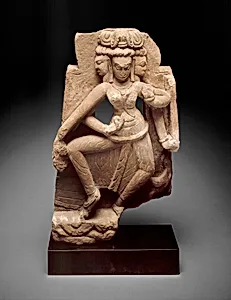
Dancing Mother Goddess Brahmani
10th century
Medium
Sandstone
Dimensions
61 × 34.3 × 14.3 cm (24 × 13 1/2 × 5 5/8 in.)
Classification
sandstone
Department
Arts of Asia
Museum
Art Institute of Chicago
Accession Number
130619
Rights
Public Domain
Art Historical Context
### Dancing Mother Goddess Brahmani striking 10th-century sandstone, measuring 61 × 34.3 × 14.3 cm, the Dancing Mother Goddess Brahmani in lively, dynamic pose. Carved by an unknown artist, it hails from the Arts of Asia collection at the Art Institute of Chicago. Sandstone, a favored medium in medieval Indian sculpture, allowed artisans to achieve fine details while ensuring durability for temple installations. The goddess's fluid dance suggests movement and vitality, embodying divine energy. Brahmani, one of revered Matrika (Mother Goddesses) in Hindu mythology, is associated with Brahma, the creator god. These fierce yet protective deities often flanked main temple shrines, warding off evil and symbolizing maternal power. Dating to the 10th century—a peak of regional dynasties like the Chola or Chandela—such works reflect the era's devotion to Shakti, the feminine divine force, blending spirituality with artistic exuberance. Artistically, the sculpture showcases masterful carving techniques, from intricate jewelry and flowing garments to expressive features that convey grace and authority. Though its exact provenance remains mysterious, it offers visitors a window into ancient India's rich sculptural tradition, where stone came alive with myth and motion.
About the Artist
Unknown
The artist designated as "Unknown" in our virtual museum's collection exemplifies a poignant chapter in art history: creators whose identities have faded into obscurity despite the enduring power of their work. With only one known artwork attributed to them in our holdings, this figure represents countless anonymous hands that shaped visual culture across centuries. Museums worldwide, including th...