
Dandelions for the New Year
19th century
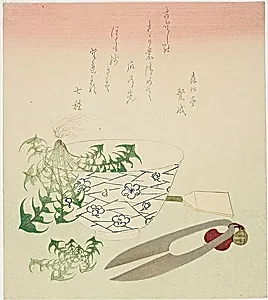
Medium
Color woodblock print; surimono
Dimensions
20.6 × 18.4 cm (8 1/8 × 7 1/4 in.)
Classification
woodblock print
Department
Arts of Asia
Museum
Art Institute of Chicago
Accession Number
81684
Rights
Public Domain
Art Historical Context
Katsushika Hokusai's *Dandelions for the Year* (19th century) is a delightful example of surimono, a type of color woodblock print commissioned for private distribution, often as New Year's greetings among Japan's cultured elite. Measuring just 20.6 × 18.4 cm, this intimate work from the Art Institute of Chicago's Arts of Asia captures Hokusai's mastery of ukiyo-e, the "pictures of the floating world" movement that celebrated ephemeral beauty in everyday life. Hokusai, the legendary artist behind *The Great Wave off Kanagawa* and his *Thirty-six Views of Mount Fuji* series, infused surimono with poetic elegance. These prints featured embossing, mica flecks, and vibrant pigments applied through precise woodblock carving—techniques that elevated them beyond commercial ukiyo-e. The dandelions here likely evoke wishes for prosperity and renewal, aligning with New Year's traditions in Edo-period Japan (1603–1868), when such gifts exchanged good fortune amid urban festivities. This gem highlights Hokusai's versatility in blending nature's simplicity with cultural ritual, offering a window into 19th-century Japan's refined artistry. A perfect pause for reflection in our virtual gallery!
About the Artist
Katsushika Hokusai · 1760–1849
Katsushika Hokusai (1760-1849) stands as one of history's most influential artists, a Japanese master who revolutionized the ukiyo-e woodblock print tradition and profoundly shaped Western art. Born in the Katsushika district of Edo (modern-day Tokyo) to an artisan family, Hokusai lived through nearly nine decades of extraordinary creative evolution, adopting over thirty different artistic names t...