
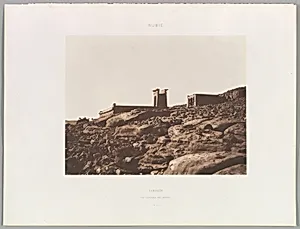
Dandoûr, Nubie
1851
Medium
Salted paper print from paper negative
Dimensions
Image: 23.9 × 31.1 cm (9 7/16 × 12 1/4 in.)
Classification
Photographs
Department
Photographs
Museum
Metropolitan Museum of Art, New York, NY
Credit
Funds from various donors, 2013
Accession Number
2013.431
Rights
Public Domain
Tags
Art Historical Context
Step into the sun-baked sands of 19th-century Nubia with Félix Teynard *Dandoûr, Nubie* (1851), a salted paper print that captures the majestic ruins of this ancient Egyptian site. Teynard, a French photographer and draftsman, ventured along the Nile during an expedition from 1851 to 1852, documenting monumental architecture with one of the era's most innovative tools: the camera. This image, measuring nearly 24 x 31 cm, reveals the weathered grandeur of Dandoûr's stone temples and columns, evoking the enduring legacy of pharaonic engineering amid desert isolation. Printed from a paper negative using the calotype process—pioneered by William Henry Fox Talbot—the work exemplifies early photography's delicate tonal range and subtle textures. Unlike crisp modern prints, salted paper yields a soft, matte glow that mirrors the ruins' patina, blending artistry with scientific precision. Teynard's photographs, including this gem now at The Metropolitan Museum of Art, were among the first to visually preserve Nubian antiquities for European audiences, fueling Egyptomania and scholarly fascination. Today, *Dandoûr, Nubie* stands as a testament to photography's power to bridge time, offering visitors a window into lost worlds while highlighting the medium's nascent role in architectural documentation.
About the Artist
Félix Teynard · 1817–1892
**Félix Teynard (1817–1892)** was a pioneering French photographer whose work captured the ancient wonders of Egypt and Nubia with unprecedented precision and artistry. Born on January 14, 1817, in Saint-Flour, he trained as a civil engineer in Grenoble, a hub of Egyptology that likely sparked his fascination with ancient architecture. Little is documented about his early life or formal photograph...