
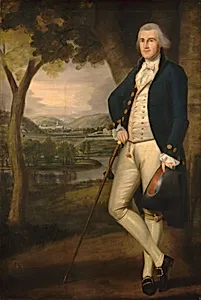
Daniel Boardman
1789
Medium
oil on canvas
Dimensions
overall: 207.4 x 140.4 cm (81 5/8 x 55 1/4 in.) framed: 228 x 160 x 10.2 cm (89 3/4 x 63 x 4 in.)
Classification
Painting
Department
CAB
Museum
National Gallery of Art, Washington, D.C.
Credit
Gift of Mrs. W. Murray Crane
Accession Number
1948.8.1
Rights
Public Domain
Art Historical Context
**Daniel Boardman**, painted by Ralph Earl in 1789, is a striking oil-on-canvas portrait that captures the poised elegance of its sitter, a prominent New England merchant. At over eight feet tall, this monumental work exemplifies the grandeur of late 18th-century American portraiture, where large-scale canvases conveyed status and prosperity in the young republic. Earl, a key figure in early American painting, drew from British influences like those of Gainsborough while developing a distinctly Yankee realism, rendering fabrics, faces, and settings with meticulous detail. Completed just after the U.S. Constitution's ratification, the portrait reflects a nation eager to assert its cultural sophistication post-Revolution. Oil on canvas allowed Earl to layer rich glazes for lifelike skin tones and textured clothing, techniques that highlighted the sitter's refined attire and setting—likely evoking commerce and landed gentry. Housed in the National Gallery of Art thanks to a generous gift, this piece offers visitors a window into the emerging American elite, blending European tradition with New World ambition. (178 words)
About the Artist
Ralph Earl · 1751–1801
Ralph Earl (1751–1801) was born on May 11 in Shrewsbury or Leicester, Massachusetts, the eldest of four children to Ralph Earle, a colonel in the Revolutionary army, and Phebe Whittemore Earl. Growing up amid farmers and craftsmen in Worcester County, Earl displayed prodigious talent as a self-taught artist, emulating the works of John Singleton Copley after observing his half-brother Henry Pelham...