
Danse
1893
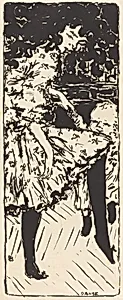
Medium
lithograph in black on china paper
Dimensions
image: 21.4 x 8.5 cm (8 7/16 x 3 3/8 in.) sheet: 34.7 x 18 cm (13 11/16 x 7 1/16 in.)
Classification
Department
CG-E
Museum
National Gallery of Art, Washington, D.C.
Credit
Virginia and Ira Jackson Collection, gift in memory of Virginia H. Jackson
Accession Number
2006.155.10
Rights
Public Domain
Art Historical Context
**Danse, Pierre Bonnard, 1893** Step into the vibrant world of-de-siècle Paris with Pierre Bonnard's *Danse*, a delicate lithograph created when the artist was just 26. Rendered in bold black ink on fine china paper—a thin, translucent Asian paper prized for its ability to capture rich, velvety tones—this intimate print measures a compact 21.4 x 8.5 cm. Bonnard, a key figure in the Post-Impressionist group Les Nabis, drew inspiration from Japanese ukiyo-e prints and Gauguin's decorative symbolism, favoring flattened forms, rhythmic patterns, and a sense of joyful intimacy over strict realism. This early work showcases Bonnard's mastery of lithography, a planar printing technique that allowed his fluid, spontaneous lines to evoke movement and lyricism—perfectly suiting the theme of dance. Produced during a period when the Nabis revolutionized printmaking with their emphasis on color, pattern, and everyday poetry, *Danse* reflects the avant-garde spirit of 1890s France, bridging painting and graphic arts. Now part of the National Gallery of Art's Virginia and Ira Jackson Collection, it offers visitors a glimpse into Bonnard's evolution toward his later luminous domestic scenes. (198 words)
About the Artist
Pierre Bonnard · 1867–1947
Pierre Bonnard (1867–1947) was a French painter and printmaker who became a leading figure in the Post-Impressionist movement and a founding member of Les Nabis. Born on October 3, 1867, in Fontenay-aux-Roses, France, Bonnard initially studied law at his father's insistence, graduating and briefly practicing as a barrister in 1888. However, his true passion lay in art, and he had simultaneously at...