
Sketches
1834–75
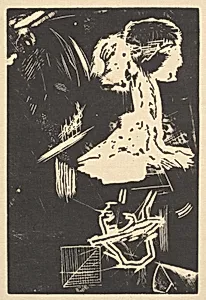
Medium
Woodcut on wove paper; second (final) state; posthumous impression
Dimensions
block: 5 9/16 x 3 3/4 in. (14.2 x 9.5 cm)
Classification
Prints
Department
Drawings and Prints
Museum
Metropolitan Museum of Art, New York, NY
Credit
Gift of Dr. Van Horne Norrie, 1917
Accession Number
17.34.12
Rights
Public Domain
Tags
Art Historical Context
Jean-François Millet, a pioneering French Realist painter associated with the Barbizon School created this intimate woodcut titled *Sketches* sometime between 1834 and 1875. Known for his empathetic portrayals of rural peasant life, Millet occasionally explored printmaking, and this work exemplifies his experimental side. The medium—a woodcut on wove in its second (final) statehighlights the tactile precision of printing, where the artist carves away negative space from a woodblock to produce bold, graphic lines. Measuring just 5 9/16 x 3 3/4 inches, its small scale invites close contemplation, revealing the simplicity and directness of Millet's draftsmanship. As a posthumous impression, this print was struck from the block after Millet's death in 1875, preserving his vision for future generations. Housed in the Metropolitan Museum of Art's Drawings and Prints department (gift of Dr. Van Horne Norrie, 1917), it tagged with "Abstraction" suggests a departure from Millet's typical figurative scenes toward more suggestive, non-literal forms—perhaps preparatory studies emphasizing line and form over detailed narrative. Woodcuts like this were significant in 19th-century France for democratizing art, allowing wider dissemination of an artist's ideas beyond paintings. This modest yet evocative piece offers a window into Millet's creative process, bridging his grounded realism with proto-modern abstraction, and reminds us how even sketches can capture the essence of an artist's hand.
About the Artist
Jean-François Millet · 1814–1875
Jean-François Millet (1814-1875) was a French painter and one of the founders of the Barbizon school, whose dignified depictions of peasant laborers transformed how art could represent rural life. His monumental images of sowers, gleaners, and field workers elevated common people to subjects previously reserved for mythological or historical figures, making him a pivotal figure in the development ...