
Dansende boerenparen
Medium
engraving
Dimensions
49; 72
Rights
Public Domain
About this artwork
plaatrand: hoogte 49 mm x breedte 72 mm
Art Historical Context
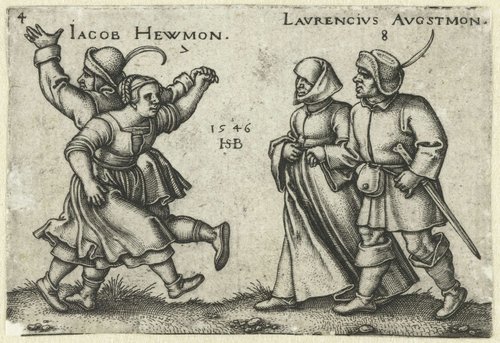
**Dansende boerenparenDancing Peasant Couples)** Hans Sebald Beham, 1546 Engraving, 49 × 72 mm Step into the lively world of 16th-century rural Germany with Hans Sebald Beham's engraving *Dansende boerenparen or "Dancing Peasant." Created in 1546, thisutive print (just 49 mm high and 72 mm wide) captures joyful peasant pairs mid-dance, a favorite motif for Beham, one of the acclaimed "Little Masters" of Northern Renaissance. These artists, including Beham, excelled in tiny, intricate engravings that packed grand detail into pocket-sized formats, making art accessible to a broad audience beyond the elite. Beham, a Nuremberg native and master engraver, employed the burin tool to incise fine lines into a metal plate, producing rich tonal contrasts and precise textures in this medium. The technique allowed for mass reproduction via printing, revolutionizing how images of everyday life—rustic revelry, folk customs—spread across Europe during the Reformation era. His style blends Renaissance realism with genre scenes, offering a vivid snapshot of peasant culture amid social upheavals. This work exemplifies Beham's prolific output of over 250 engravings, highlighting the cultural fascination with lower-class merriment. It invites us to ponder the peasants' unbridled joy, a counterpoint to the era's religious tensions, reminding visitors of art's power to preserve fleeting moments of human connection.
About the Artist
Hans Sebald Beham · 1500–1550
Sebald Beham (1500-1550), often called Hans Sebald Beham, was a German painter and printmaker born in Nuremberg. He stands as the most important figure among the Kleinmeister (Little Masters), a group of German artists who created remarkably detailed prints on a diminutive scale in the generation following Albrecht Dürer. Beham's significance lies in his technical virtuosity and unprecedented pro...