
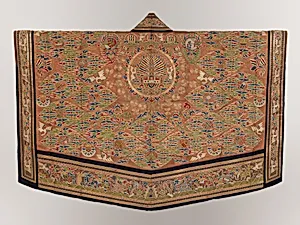
清早期 刺繡道教袶衣|Daoist priest’s robe
Unknown Artist
18th century
Medium
Silk and metallic thread embroidery on satin
Dimensions
Overall: 54 x 73 in. (137.2 x 185.4 cm)
Classification
Costumes-Embroidered
Culture & Period
China · Qing dynasty (1644–1911)
Department
Asian Art
Museum
Metropolitan Museum of Art, New York, NY
Credit
Bequest of William Christian Paul, 1929
Accession Number
30.75.3
Rights
Public Domain
Tags
Art Historical Context
This exquisite Daoist priest’s robe, crafted in early Qing dynasty China during the 18th century exemplifies the opulent craftsmanship of imperial-era religious attire. Dating to the Qing period (1644–1911), when Daoism flourished alongside Confucian and Buddhist traditions, such robes were worn by priests during rituals invoking harmony between heaven and earth. Donated to the Metropolitan Museum of Art in 1929 through the bequest of William Christian Paul, this garment measures an impressive 54 x 73 inches, designed to drape majestically over the wearer. Masterfully embroidered on luxurious satin with silk and metallic threads, the robe showcases intricate techniques like couching and satin stitch, which allowed for shimmering effects that mimicked divine light. Prominent motifs of dragons—symbols of imperial power and cosmic energy—and cranes, emblems of longevity and immortality—adorn the fabric, reflecting Daoist cosmology where these creatures bridge the mortal and spiritual realms. The use of metallic threads elevated the robe's status, making it a wearable talisman for ceremonies. As a rare surviving example of embroidered costume from Qing China, this robe offers a window into the fusion of artistry, spirituality, and hierarchy in 18th-century society, inviting visitors to appreciate the enduring reverence for Daoist mysticism.