
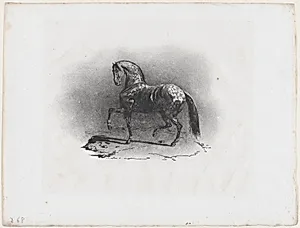
Dappled Horse
Medium
Lithograph
Dimensions
sheet: 10 5/8 x 13 7/8 in. (27 x 35.3 cm) plate: 6 5/16 x 8 7/8 in. (16 x 22.5 cm)
Classification
Prints
Department
Drawings and Prints
Museum
Metropolitan Museum of Art, New York, NY
Credit
The Elisha Whittelsey Collection, The Elisha Whittelsey Fund, 1953
Accession Number
53.528.3
Rights
Public Domain
Tags
Art Historical Context
**Dappled Horse** (1823) by Théodore Géricault captures the raw power and elegance of equine form in a striking lithograph from the collection of the Metropolitan Museum of. Created just a year before the French Romantic artist's untimely death at age 32 this print showcases Géricault's lifelong obsession with horses, which he studied meticulously in stables and racetracks. As a leader of Romanticism, Géricault rejected classical ideals for dramatic, emotive subjects, and his horses often symbolized untamed vitality and human struggle—echoing themes in masterpieces like *The Raft of the Medusa* (1819). Lithography, a revolutionary medium invented in the late 18th century, allowed Géricault to achieve fluid, painterly effects akin to drawing directly on stone with greasy crayon. The modest plate size (6 5/16 x 8 7/8 in.) belies its technical brilliance: subtle dappled shading renders the horse's muscular anatomy and textured coat with remarkable realism and depth. Produced during Géricault's experimental phase with prints in the 1820s, it exemplifies early lithography's potential for mass reproduction while preserving an artist's intimate touch. This intimate study invites visitors to appreciate how Géricault transformed a simple horse portrait into a celebration of nature's dynamism, bridging fine art and printmaking in 19th-century Europe. (198 words)
About the Artist
Théodore Gericault · 1791–1824
Théodore Géricault, born Jean-Louis André Théodore Géricault on September 26, 1791, in Rouen, France, into a prosperous family—his father a lawyer turned tobacco merchant and his mother from a line of growers—moved to Paris around 1797. Displaying early artistic promise, recognized by painter Jean-Louis Laneuville, he began formal training in 1808 under Carle Vernet, mastering English sporting art...