
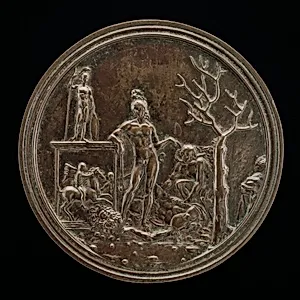
David Triumphant over Goliath
1507 or before
Medium
bronze//Dark brown patina (rubbed on raised surfaces)
Dimensions
overall (diameter): 10.63 cm (4 3/16 in.) gross weight: 135.51 gr (0.299 lb.)
Classification
Sculpture
Department
CSD
Museum
National Gallery of Art, Washington, D.C.
Credit
Samuel H. Kress Collection
Accession Number
1957.14.286
Rights
Public Domain
Art Historical Context
Behold the exquisite bronze plaquette *David Triumphant over Goliath* by Galeazzo Moderno crafted by 1507. This small-scale masterpiece, measuring just 10.63 cm in diameter and weighing 135.51 grams, exemplifies the Renaissance fascination with biblical heroism. Cast in bronze with a rich dark brown patina—polished smooth on raised surfaces through centuries of handling—it captures the moment of David's victory, a timeless symbol of intellect and faith prevailing over brute force. Moderno, a skilled Paduan sculptor active in northern Italy, specialized in such intimate reliefs, blending classical antiquity with contemporary religious themes. Plaques like this were prized Renaissance collectibles, often adorning cabinets of curiosities among scholars and nobility. The intricate modeling and dynamic composition reflect the era's mastery of bronze casting, where artists poured molten metal into molds to achieve fine details in miniature form. Housed in the National Gallery of Art as part of the Samuel H. Kress Collection, this work invites us to ponder the cultural resonance of David's story—from Florentine civic pride to universal underdog tales. Its worn patina whispers of devoted admirers across five centuries, making it a tangible link to Renaissance ingenuity.
About the Artist
Moderno · 1467–1528
Galeazzo Mondella, known to history as Moderno, was born in Verona in 1467 and became one of the most accomplished and widely admired creators of bronze plaquettes during the Italian Renaissance. He joined the Goldsmiths' Guild of Verona in 1485 at the age of eighteen, and by 1487 he had begun working at the court of Mantua, where he adopted the name Moderno—chosen in deliberate counterpoint to hi...