
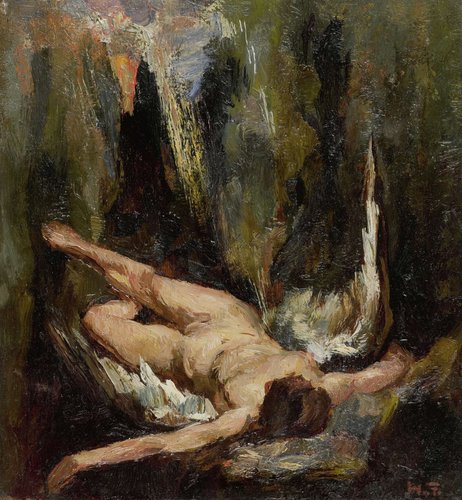
De gevallen engel
1885 - 1931
Medium
oil on panel
Dimensions
10; 20; 17.5
Rights
Public Domain
About this artwork
…; collection Dominicus Antonius Josephus Kessler (1855-1939) and Mrs A.C.M.H. Kessler-Hülsmann (1868-1947), Kapelle op den Bosch, near Mechelen, ?1932;{The Hague 1932, p. 11, no. 65.} donated, with xx other objects, by Mrs A.C.M.H. Kessler-Hülsmann to the museum, 1940
Art Historical Context
**De gevallen engel (The Fallen Angel)** Willem de Zwart's *De gevallen engel*, painted in oil on panel, captures a poignant biblical motif—the dramatic fall of Lucifer from grace—in an intimate format of just 20 x 17.5 cm. This small-scale work, housed in the Rijksmuseum, reflects the Dutch artist's early career around the 1880s, during a period when he was emerging as a versatile painter influenced by the Hague School's realistic tendencies and later Impressionist light effects. De Zwart (1862–1931), known for his luminous landscapes and portraits, here turns to symbolic, emotive themes, using the compact panel to evoke profound spiritual turmoil with rich oils that allow for textured depth and subtle modeling. The painting's historical journey adds intrigue: it entered the collection of Dominicus Antonius Josephus Kessler and his wife A.C.M.H. Kessler-Hülsmann in Kapelle op den Bosch near Mechelen, Belgium, and was exhibited in The Hague in 1932. Donated to the Rijksmuseum in 1940 alongside other treasures, it embodies the cultural exchanges between Dutch and Belgian collectors during the interwar years. Oil on panel, a traditional medium favored for its durability and portability, underscores the work's personal, devotional quality, inviting visitors to ponder themes of hubris and redemption up close in the museum's galleries.
About the Artist
Willem de Zwart · 1862–1931
Painter of animal studies, landscapes, townscapes, figure pieces, and still lifes. Comment on works: painter