
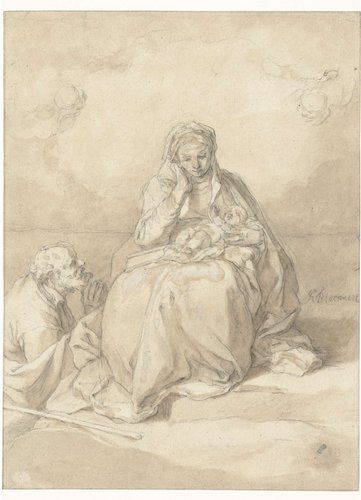
De heilige Familie
1640 - 1651
Medium
brush
Dimensions
202; 270
Rights
Public Domain
About this artwork
hoogte 270 mm x breedte 202 mm
Art Historical Context
Abraham Bloemaert's *De heilige Familie* (The Holy Family), created between 1640 and1651, offers an intimate glimpse into one of the most cherished themes of Christian art. This delicate brush work, measuring just 270 mm high by 202 mm wide, captures the tender bond between Mary, Joseph, and the Christ child in a moment of quiet devotion. Produced late in Bloemaert's—he lived from 1566 to 1651—it reflects the Dutch master's enduring fascination with religious subjects during the Golden Age. As a leading figure in Utrecht, Bloemaert bridged Mannerism and the emerging Baroque style, influenced by Caravaggio's dramatic chiaroscuro through the Utrecht Caravaggisti circle. His brush technique here emphasizes fluid lines and subtle tonal washes, showcasing his skill in small-scale studies that often served as preparations for larger paintings or served devotional purposes. The compact format invites close contemplation, highlighting the humanity within the divine. This artwork underscores the cultural importance of Holy Family depictions in 17th-century Northern Europe, blending spiritual reverence with artistic innovation. Visitors will appreciate how Bloemaert's economical medium conveys profound emotion, a testament to Dutch mastery in drawing traditions.
About the Artist
Abraham Bloemaert · 1566–1651
Abraham Bloemaert (1566–1651) was born in Gorinchem in the Dutch Republic, the son of architect Cornelis Bloemaert, and grew up in Utrecht after the family relocated there in 1575. His early artistic formation took him to Paris for three years in the early 1580s, where he studied with several masters before returning to the Northern Netherlands to pursue his career. He settled permanently in Utrec...