
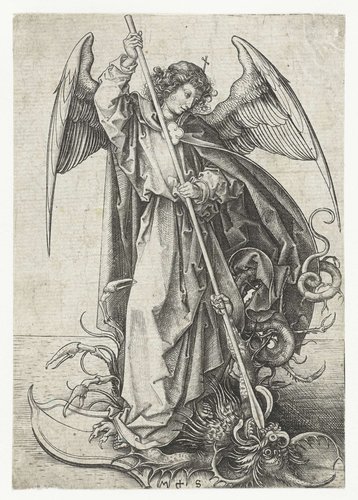
De Heilige Michaël en de draak
c. 1470 - 1491
Medium
engraving
Dimensions
160; 112
Rights
Public Domain
About this artwork
gravure
Art Historical Context
**De Heilige Michaël en draak (Saint Michael and the Dragon Martin Schongauer, c. 1470–1491 Engraving, 160 × 112 mm Behold Martin Schongauer’s masterful engraving *De Heilige Michaël de draak*, a depiction of the archangel Michael triumphing over the dragon, symbolizing the eternal battle between good and evil in Christian iconography. Created during the late 15th century in the German-speaking regions of the Holy Roman Empire, this work exemplifies the Northern Renaissance’s blend of Late Gothic detail and emerging realism. Schongauer, one of the era’s pioneering engravers from Colmar, Alsace, produced around 120 plates, influencing masters like Albrecht Dürer with his intricate line work and expressive figures. The engraving medium was revolutionary: copper plates allowed for multiple impressions, democratizing religious art beyond elite patrons to pilgrims and the devout across Europe. Schongauer’s technique shines in the dynamic composition—Michael poised mid-strike, feathers and scales rendered with fine, parallel hatching for depth and texture. At just 160 by 112 mm, its small scale belies monumental drama, perfect for personal devotion or portable altarpieces. This piece highlights engraving’s cultural role in the pre-Reformation age, spreading vivid biblical narratives and fostering spiritual reflection. A testament to Schongauer’s legacy as a bridge between medieval and Renaissance art, it invites you to trace every meticulous line and ponder the dragon’s defeat.
About the Artist
Martin Schongauer · 1435–1491
Martin Schongauer, born around 1450–1453 in Colmar, Alsace, emerged from a family of skilled artisans. The third of four or five sons of goldsmith Caspar Schongauer, who had relocated from Augsburg to Colmar around 1440, Martin was immersed in the goldsmith's trade from youth, likely receiving his initial training in his father's workshop—a common path for early engravers. He further honed his ski...