
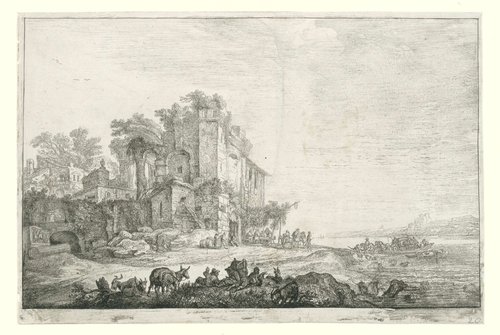
De herberg in een ruïne
1610 - 1653
Medium
etching
Dimensions
285; 190
Rights
Public Domain
About this artwork
Een antiek ruïne waarin een herberg is gevestigd aan de oever van een brede rivier. Een veerpond met koets en paarden meert aan. Vóór de herberg een aantal gasten, op de voorgrond herders met geiten, een reiziger en twee pakezels.
Art Historical Context
Simon de Vlieger (c. 1601–1653), a prominent Dutch Golden Age artist, the rustic charm of 17th-century life in his etching *De herberg in een ruïne (The Inn in a Ruin). Active during the Netherlands' prosperous era of maritime trade and landscape innovation, de Vlieger specialized in detailed marine and dune scenes, influenced by masters like Jan van Goyen. This print, measuring 190 × 285 mm, exemplifies the era's fascination with tonal landscapes and everyday narratives. The composition unfolds along a broad riverbank, where an ancient ruin ingeniously shelters a bustling inn. A ferryboat laden with a coach and horses docks nearby, while foreground figures—herders tending goats, a weary traveler, and sturdy pack mules—add lively human scale. Guests mingle outside the inn, evoking the transient world of trade routes and river travel. De Vlieger's etching technique, using acid-etched lines on a metal plate for subtle textures and atmospheric depth, allowed affordable reproduction of such evocative scenes, popular among collectors. This work reflects Dutch cultural reverence for pastoral idylls amid classical ruins, blending realism with romantic nostalgia. It highlights etching's role in democratizing art, making Golden Age visions accessible beyond oil paintings. A delightful window into a bygone era of journeys and hospitality!
About the Artist
Simon de Vlieger · 1600–1653
Simon de Vlieger (c. 1600/1601–1653) was a leading Dutch marine painter of the Golden Age, born in Rotterdam where he married Anna Gerridts van Willige in 1627. His early training remains undocumented, though his initial works reflect the influence of tonal marine painting pioneered by Jan Porcellis, from whose monochrome palette de Vlieger transitioned toward more vibrant colors, precise ship det...