
De kamer idylle
1831
Medium
wood engraving
Dimensions
77; 41; 186; 260
Rights
Public Domain
About this artwork
Het houtblok bevindt zich in het British Museum. Botke, K.
Art Historical Context
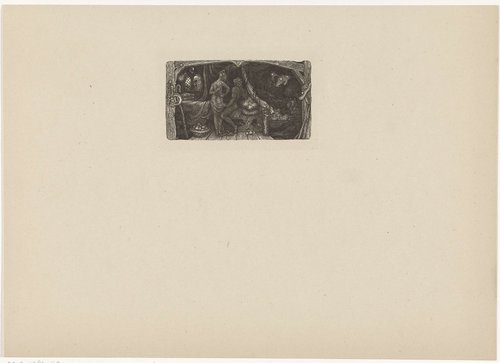
Edward Calvert's *De kamer idylle* (The Room Idyll created in 1831, is a delicate wood engraving measuring just 41 mm high by 77 mm wide—small enough to fit in the palm of your hand. As a British artist deeply influenced by William Blake and the visionary Shoreham Ancients circle, Calvert infused his works with romantic, pastoral ideals, evoking, almost mythical domestic harmony. This intimate scale suggests it was designed for intimate viewing, perhaps as a book illustration or private print, capturing the Romantic era's fascination with idyllic simplicity amid the Industrial Revolution's upheavals. Wood engraving, Calvert's chosen medium, allowed for fine, intricate lines carved into end-grain wood blocks, enabling sharp reproductions that rivaled copper engravings. This technique marked a technical evolution in printmaking during the early 19th century, bridging handmade artistry with emerging mass production. Calvert's precise style reflects his commitment to symbolic, nature-infused narratives, blending classical motifs with personal spirituality. Remarkably, the original woodblock resides in the British Museum, a testament to its enduring value (as noted by scholar K. Botke). For visitors, this tiny gem offers a window into Calvert's dreamlike world, reminding us how art can distill profound tranquility into the smallest spaces.