
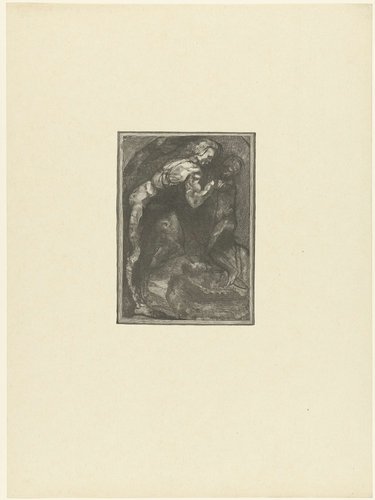
Michelangelo beeldhouwt een slaaf
1894
Medium
wood engraving
Dimensions
149; 107
Rights
Public Domain
About this artwork
beeld: hoogte 149 mm x breedte 107 mm
Art Historical Context
**Michelangelo Beeldhouwt een Slaaf (Michelangelo Sculpting a Slave)** *Auguste Lepère, 1894, wood engraving, 149 × 107 mm* This intimate wood engraving by French artist Auguste Lepère captures a timeless moment: the Renaissance master Michelangelo at work chiseling one of his iconic "Slave" figures, likely inspired by the unfinished Prisoners intended for Pope Julius II's tomb. in 1894, during the height of France's wood engraving revival, print reflects 19th-century Romantic fascination with artistic genius and the physical labor of creation. Lepère, a leading illustrator of his era (1849–1918), drew from historical imagination to evoke the intensity of Michelangelo's studio. Wood engraving, Lepère's specialty, allowed for exquisite detail in a small format—here, just 149 × 107 mm—mimicking the texture of marble and the play of light on flesh through fine, cross-hatched lines. Unlike earlier reproductive prints, Lepère's technique infused prints with a painterly quality, bridging fine art and mass reproduction for books and journals. His works often celebrated urban life and historical subjects, making this piece a nod to enduring artistic heritage. For visitors, this engraving invites reflection on the sculptor's struggle—figures emerging half-formed from stone, symbolizing the human spirit's fight for freedom. A gem of late 19th-century printmaking, it showcases Lepère's mastery in honoring a Renaissance titan. (198 words)
About the Artist
Auguste Lepère · 1849–1918
Auguste-Louis Lepère (1849–1918), son of the sculptor François Lepère, was born in Paris on November 30, 1849, into an artistic family that shaped his early path. At age thirteen, he apprenticed in the Paris studio of the English wood engraver Joseph Burn Smeeton, honing his skills in wood engraving until 1867. He furthered his training with drawing classes under Horace Lecoq de Boisbaudran at the...