
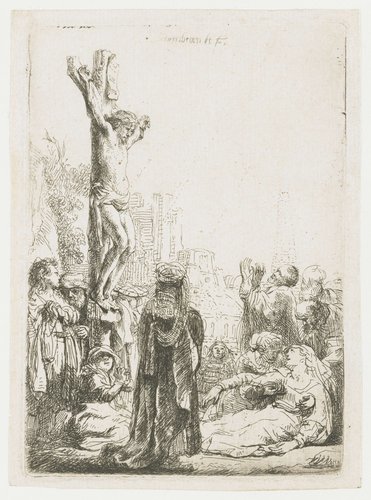
De kruisiging: kleine plaat
ca. 1635
Medium
etching
Dimensions
67; 95
Rights
Public Domain
About this artwork
ets
Art Historical Context
Rembrandt van Rijn'sDe kruisiging: plaat* (The Crucifixion: Small Plate created around 1635, is a masterful etching measuring just 95 mm high by 67 mm wide. During this early phase of his career in Amsterdam, Rembrandt was revolutionizing printmaking, blending intricate detail with emotional depth in his Baroque style. This diminutive work captures the harrowing biblical scene of Christ's crucifixion, showcasing his signature use of chiaroscuro—ramatic contrasts of light and shadow—to evoke pathos and spirituality. As an etching, the piece highlights Rembrandt's innovative technique: he bit the copper plate with acid to create fine, expressive lines, allowing for textures from the rough cross to the figures' anguished poses. Known as the "small plate" to distinguish it from a larger version, it demonstrates his versatility in scaling grand narratives to intimate formats, making religious art accessible to a wider audience through affordable prints. This work reflects the 17th-century Dutch Golden Age's fascination with faith and humanism, where Rembrandt infused sacred subjects raw humanity. A gem for collectors, it underscores his enduring legacy as etching's greatest innovator, inviting viewers to ponder suffering and redemption up close.
About the Artist
Rembrandt van Rijn · 1606–1669
Rembrandt Harmenszoon van Rijn (1606–1669) stands as one of the greatest visual artists in the history of Western art and the most important Dutch painter of the 17th century. Born in Leiden to a prosperous miller's family, Rembrandt transformed painting through his revolutionary use of light and shadow, his psychological depth in portraiture, and his elevation of etching to a fine art. His approx...