
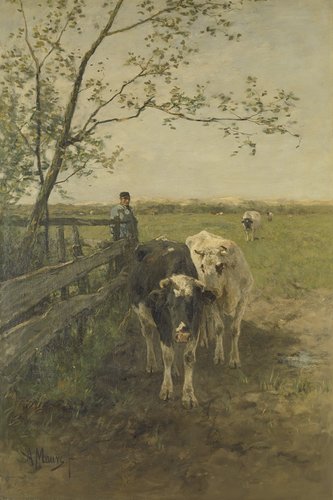
De melkbocht
1870 - 1888
Medium
oil on canvas
Dimensions
115; 171; 6.5
Rights
Public Domain
About this artwork
signatuur, linksonder, A Mauve f.
Art Historical Context
Anton Mauve’s *De melkbocht* (c. 1870–1888) captures the quiet rhythms of Dutch rural life during the late nineteenth century. As a leading figure of the Hague School, Mauve specialized in atmospheric landscapes and peasant scenes, drawing inspiration from the French Barbizon painters while remaining rooted in the flat, luminous countryside of the Netherlands. The large canvas—over 1.7 meters tall—suggests an ambitious work intended to immerse viewers in the everyday world of milk delivery along a country bend, a common sight in the polder landscapes of Mauve’s time. Painted in oil on canvas, the medium allowed Mauve to build rich textures and subtle gradations of light, hallmarks of Hague School realism. His restrained palette and loose yet precise brushwork evoke the changing skies and damp earth of the Dutch countryside without idealization. The signature “A Mauve f.” in the lower left confirms the artist’s personal touch on this sizable composition, now preserved at the Rijksmuseum. Today the painting offers modern visitors a window into a vanishing agrarian world, celebrating both the dignity of rural labor and the poetic beauty of ordinary Dutch scenery.
About the Artist
Anton Mauve · 1838–1888
Anton Mauve (1838–1888), born Anthonij Rudolf Mauve in Zaandam, Netherlands, hailed from a family of North Holland clergymen. At age 16, he apprenticed under animal painter Pieter Frederik van Os in Haarlem, mastering depictions of livestock, before studying briefly with Wouterus Verschuur, whose equine subjects instilled a lifelong affinity for horses. He honed his plein air technique alongside P...