
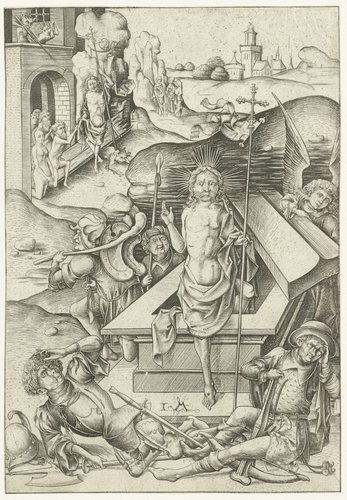
De opstanding
1455 - 1503
Medium
engraving
Dimensions
210; 145
Rights
Public Domain
About this artwork
collector's mark: Lugt 2228
Art Historical Context
**De Opstanding (The Resurrection)** by Israhel van Mecken (c. 1455–1503) captures a pivotal moment in Christian iconography: Christ's triumphant rising from the tomb. This engraving, measuring 210 mm high by 145 mm wide, exemplifies the artist's mastery during the late Gothic period in Northern Europe. Van Meckenem, a prolific German engraver and goldsmith from Mecem, produced hundreds of prints that blended intricate detail with spiritual fervor, often drawing from contemporary masters like Martin Schongauer. Engraving as a medium was revolutionary in the 15th century, allowing for precise, reproducible images on copper plates that could be inked and pressed onto paper. Van Meckenem's technique shines in the fine cross-hatching and delicate lines that convey texture, light, and emotion—hallmarks of early printmaking's rise. These affordable prints democratized religious art, enabling devotion beyond church walls and fostering a burgeoning market for portable piety. Bearing the collector's mark Lugt 2228 (Eugène Dutuit), this work highlights its esteemed provenance, linking it to renowned 19th-century collections. As a window into late medieval faith and artistry, *De Opstanding* invites us to marvel at how a small metal plate could inspire countless souls.
About the Artist
Israhel van Meckenem · 1435–1503
Israhel van Meckenem (c. 1445–1503), also known as Israhel van Meckenem the Younger, was a pioneering German engraver and goldsmith based in Bocholt, near the Dutch border, renowned as the most prolific printmaker of the fifteenth century. Born into a family possibly of Dutch origin, he was the son of Israhel van Meckenem the Elder, a goldsmith who settled in Bocholt in 1457. He trained initially ...