
De paarse schelp
Medium
nishikie, with metallic pigments
Dimensions
174; 192
Rights
Public Domain
About this artwork
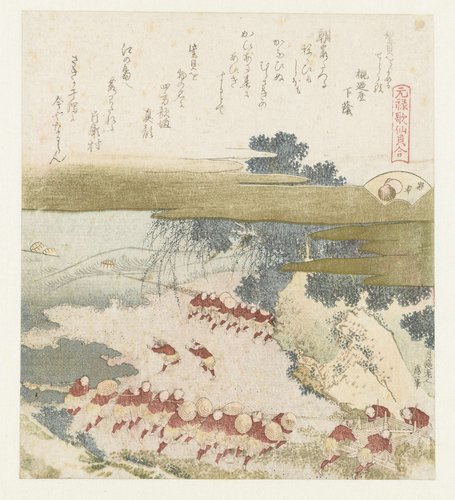
Twee groepen vissers trekken een walvis op het droge. De locatie is het dorp Katase, tegenover Enoshima eiland. De schelp waar de titel naar verwijst is afgebeeld in het waaiervormige cartouche. Met twee gedichten.
Art Historical Context
**De Paarse Schelp (The Purple Shell)** by Katsushika Hokusai, created in 1821, is a exquisite example of *nishikie*—vibrant woodblock prints as "brocade pictures" for their rich colors and intricate details. Measuring just 192mm by 174mm, this compact work showcases Hokusai's mastery ukiyo-e, the Japanese art of pictures of the floating world, capturing fleeting moments of everyday life and nature during Japan's Edo period. The use of metallic pigments adds a luxurious shimmer, elevating it beyond standard prints to the realm of elite *surimono* commissions, often exchanged as New Year's greetings among poets and patrons. The scene depicts two groups of determined fishermen hauling a massive whale ashore at Katase village, directly across from the scenic Enoshima Island—a real coastal spot near modern-day Fujisawa, renowned for its fishing heritage and spiritual significance. Whaling was a vital, perilous industry in 19th-century Japan, symbolizing human struggle against nature's power. At the center, a fan-shaped cartouche features the titular purple shell, a striking motif that ties into the print's poetic elegance, accompanied by two inscribed poems that invite reflection on beauty and transience. Hokusai, famed for icons like *The Great Wave*, infused this piece with dynamic composition and vivid storytelling, blending realism with cultural reverence for the sea. Its small scale belies its big impact, offering visitors a window into Japan's whaling traditions and the artistry of metallic-enhanced printing.
About the Artist
Katsushika Hokusai · 1760–1849
Katsushika Hokusai (1760-1849) stands as one of history's most influential artists, a Japanese master who revolutionized the ukiyo-e woodblock print tradition and profoundly shaped Western art. Born in the Katsushika district of Edo (modern-day Tokyo) to an artisan family, Hokusai lived through nearly nine decades of extraordinary creative evolution, adopting over thirty different artistic names t...