
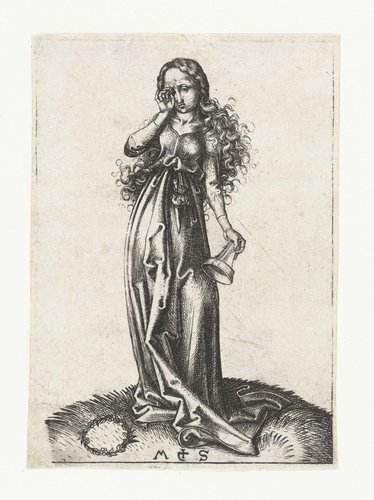
De wijze en de dwaze maagden
ca. 1470 - 1491
Medium
engraving
Dimensions
87; 122
Rights
Public Domain
About this artwork
collector's mark: Lugt 240
Art Historical Context
Behold Martin Schongauer's *De wijze en de dwaze maag* (The Wise and the Fool Virgins), a masterful engraving from around 1470–1491. This small yet intricate work (122 × 87 mm) depicts the biblical parable from Matthew 25, contrasting the prepared wise virgins with lamps lit for the bridegroom's arrival against the unprepared foolish ones. Schongauer, a pioneering German artist from Colmar, captures this moral tale of vigilance and readiness with dramatic tension, a hallmark of late Gothic and early Northern Renaissance art. As one of the first great masters of engraving, Schongauer revolutionized printmaking by incising fine lines into copper plates, using cross-hatching and delicate burrs to create depth, texture, and glowing highlights in black-and-white. His technical virtuosity allowed for unprecedented detail in such a compact format, making religious imagery accessible beyond elite patrons—prints like this could be widely distributed and collected. Bearing a collector's mark (Lugt 240), this piece reflects centuries of appreciation for Schongauer's influence on artists like Albrecht Dürer. It invites us to ponder timeless themes of foresight amid the exquisite precision of 15th-century innovation. (198 words)
About the Artist
Martin Schongauer · 1435–1491
Martin Schongauer, born around 1450–1453 in Colmar, Alsace, emerged from a family of skilled artisans. The third of four or five sons of goldsmith Caspar Schongauer, who had relocated from Augsburg to Colmar around 1440, Martin was immersed in the goldsmith's trade from youth, likely receiving his initial training in his father's workshop—a common path for early engravers. He further honed his ski...