
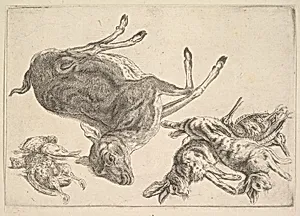
Dead deer, hares and game
Medium
Etching; only state
Dimensions
Plate: 5 3/8 × 7 3/4 in. (13.6 × 19.7 cm) Sheet: 5 9/16 × 7 13/16 in. (14.2 × 19.9 cm)
Classification
Prints
Department
Drawings and Prints
Museum
Metropolitan Museum of Art, New York, NY
Credit
The Elisha Whittelsey Collection, The Elisha Whittelsey Fund, 1951
Accession Number
51.501.1376
Rights
Public Domain
Tags
Art Historical Context
Wenceslaus Hollar's *Dead Deer, Hares and Game* (1647) is a exquisite etching capturing a still life of hunted animals, including a deer and hares, arranged with naturalistic precision. Created during Hollar's time in Antwerp—after fleeing civil unrest in England—this "only state" print measures a modest 5 3/8 × 7 3/4 inches on the plate, showcasing the Bohemian artist's mastery of the etching medium. Hollar, a prolific 17th-century printmaker known for over 2,500 works, blended Baroque detail with meticulous observation, often rivaling the finesse of engravings. Etching allowed Hollar to achieve fine lines and textures through acid biting into a metal plate, producing rich tonal contrasts that bring the limp forms and fur textures vividly to life. This technique was revolutionary for its reproducibility, making high-quality art accessible beyond paintings. The subject reflects the era's fascination with hunting trophies and *vanitas* themes, symbolizing mortality amid abundance. Housed in the Metropolitan Museum of Art's Drawings and Prints department, this piece from The Elisha Whittelsey Collection highlights Hollar's versatility—from landscapes to still lifes—offering visitors a window into 17th-century Europe's artistic ingenuity and the quiet drama of everyday mortality.
About the Artist
Wenceslaus Hollar · 1607–1677
Wenceslaus Hollar (1607-1677) was a prolific Bohemian etcher who became one of the most accomplished printmakers of the seventeenth century. Born in Prague, he trained under Matthäus Merian in Frankfurt before entering the service of Thomas Howard, Earl of Arundel, in 1636. Hollar spent most of his career in England, where he produced approximately 2,740 etchings documenting an extraordinary range...