
The Dead Hare
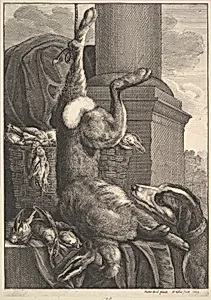
Medium
Etching; first state of three
Dimensions
Sheet: 10 3/8 × 7 3/16 in. (26.3 × 18.3 cm) trimmed c. 7 x 12 mm within platemark
Classification
Prints
Department
Drawings and Prints
Museum
Metropolitan Museum of Art, New York, NY
Credit
The Elisha Whittelsey Collection, The Elisha Whittelsey Fund, 1951
Accession Number
51.501.1407
Rights
Public Domain
Tags
Art Historical Context
Visitors to the Metropolitan Museum of Art's Drawings and Prints department are treated to *The Dead Hare*, a 1649 etching attributed to Wenceslaus Hol and Pieter Boel.lar, a Bohemian master etcher renowned for his meticulous detail and versatility, produced this work during his time in England amid the turbulent English Civil War era. The first state of three—before later alterations to the plate—offers a pristine glimpse into 17th-century printmaking with the sheet measuring 10 3/8 × 7 3/16 inches, lightly trimmed within the platemark. This etching exemplifies the Northern Baroque fascination with still life and nature morte, capturing the lifeless form of a hare alongside evocative tags of dogs and rabbits. Etching technique, involving acid-etched lines on a metal plate, allowed Hollar to render textures like fur and limp musculature with astonishing realism, blending technical precision with subtle emotional resonance. Often symbolizing the hunt's triumph or vanitas themes of mortality, such prints were prized by collectors for their lifelike quality and portability. Acquired through The Elisha Whittelsey Collection via the Elisha Whittelsey Fund in 1951, *The Dead Hare* highlights the era's blend of artistry and scientific observation, inviting us to ponder life's fragility through Hollar's unflinching gaze.
About the Artist
Wenceslaus Hollar|Pieter Boel · 1607–1677
Wenceslaus Hollar (1607-1677) was a prolific Bohemian etcher who became one of the most accomplished printmakers of the seventeenth century. Born in Prague, he trained under Matthäus Merian in Frankfurt before entering the service of Thomas Howard, Earl of Arundel, in 1636. Hollar spent most of his career in England, where he produced approximately 2,740 etchings documenting an extraordinary range...