
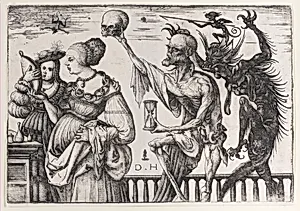
Death and the Devil Surprising Two Women
ca. 1515
Medium
Etching
Dimensions
Plate: 6 1/8 × 8 3/4 in. (15.5 × 22.3 cm) Sheet: 6 5/16 × 8 15/16 in. (16 × 22.7 cm)
Classification
Prints
Department
Drawings and Prints
Museum
Metropolitan Museum of Art, New York, NY
Credit
The Elisha Whittelsey Collection, The Elisha Whittelsey Fund, 1951
Accession Number
51.501.383
Rights
Public Domain
Tags
Art Historical Context
Daniel Hopfer’s “Death and the Devil Surprising Two Women,” created around 1515, captures a dramatic moral warning typical of early sixteenth-century Germany. In this lively etching, skeletal Death and a horned devil burst upon two unsuspecting women, underscoring the suddenness with which mortality can intrude upon everyday life. The scene belongs to the long memento mori tradition, reminding viewers to live virtuously in the face of inevitable judgment. Hopfer, working in Augsburg, was among the first artists to explore etching as an independent print medium rather than a technique reserved for decorating armor. By biting designs into iron plates with acid, he achieved fluid lines and expressive textures that were difficult to obtain with engraving alone. The resulting prints could be produced in multiples, allowing such vivid images of temptation and mortality to reach a wide audience during the turbulent years of the Reformation. Today the sheet is preserved in the Metropolitan Museum’s collection, its modest size (roughly postcard dimensions) inviting intimate contemplation. The crisp contrasts of line and shadow still convey the startling encounter with chilling clarity, demonstrating how early printmakers turned new technology into powerful tools for reflection.
About the Artist
Daniel Hopfer · 1471–1536
Daniel Hopfer (c. 1470–1536), born in Kaufbeuren, was the son of the painter Bartholomäus Hopfer and Anna Sendlerin. He relocated early to Augsburg, becoming a citizen and master painter there in 1493, and trained as an etcher of armor in this thriving center of arms production. By 1505, he owned a house in the city center and served on the guild committee for smiths, which encompassed painters an...