
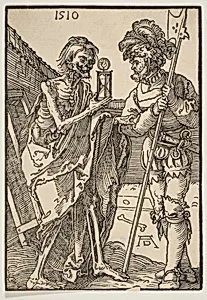
Death and the Lansquenet
n.d.
Medium
Woodcut
Dimensions
sheet: 4 13/16 x 3 5/16 in. (12.2 x 8.4 cm)
Classification
Prints
Department
Drawings and Prints
Museum
Metropolitan Museum of Art, New York, NY
Credit
George Khuner Collection, Bequest of Marianne Khuner, 1984
Accession Number
1984.1201.28
Rights
Public Domain
Tags
Art Historical Context
In Albrecht Dürer's *Death and the Lansquenet*, a master of the Northern Renaissance confronts viewers with a stark memento mori. This intimate woodcut, measuring just 4 13/16 x 3 5/16 inches, depicts Death—a skeletal figure clutching a spear—surprising a rugged lansquenet, a German mercenary soldier known for his flamboyant attire and fierce reputation during the Renaissance wars. Dürer's precise lines capture the soldier's momentary shock amid weapons and grim inevitability, embodying the era's obsession with mortality. As a pioneering printmaker, Dürer elevated woodcuts from utilitarian illustrations to high art through his exceptional technical skill. Carved into wood blocks and hand-printed, these works allowed unprecedented detail and tonal depth, making fine art accessible beyond elite patrons. Produced around the early 16th century (though undated here), it reflects the turbulent times of Reformation and warfare, where soldiers embodied both bravado and vulnerability. Housed in the Metropolitan Museum of Art's George Khuner Collection, this piece highlights Dürer's influence on printmaking and his moral themes. It reminds visitors that no status shields us from death, a timeless message wrapped in Renaissance virtuosity.
About the Artist
Albrecht Dürer · 1471–1528
Albrecht Dürer (1471–1528) stands as the preeminent figure of the Northern Renaissance and arguably the most influential artist in the history of printmaking. Born in Nuremberg on May 21, 1471, and dying in the same city on April 6, 1528, Dürer revolutionized the status of the artist in Northern Europe, transforming printmaking from a commercial craft into an independent fine art and establishing ...