
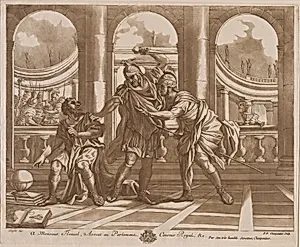
Death of Archimedes
Medium
etching and aquatint printed in brown on laid paper
Dimensions
image: 27.4 × 35.1 cm (10 13/16 × 13 13/16 in.) plate: 29.7 × 36.4 cm (11 11/16 × 14 5/16 in.) sheet: 29.8 × 57 cm (11 3/4 × 22 7/16 in.)
Classification
Department
CG-E
Museum
National Gallery of Art, Washington, D.C.
Credit
Pepita Milmore Memorial Fund
Accession Number
2018.91.21
Rights
Public Domain
Art Historical Context
This 1766 print captures the dramatic final moments of the ancient Greek mathematician Archimedes during the Roman siege of Syracuse in 212 BCE. According to legend, the scholar was absorbed in geometric diagrams drawn in the sand when a soldier struck him down, ignoring his plea to spare his work. The scene underscores themes of intellectual devotion amid conflict, a subject that resonated across centuries as a symbol of the fragile pursuit of knowledge. François-Philippe Charpentier created this etching and aquatint after an earlier composition by the Baroque painter Ciro Ferri, a follower of Pietro da Cortona. Printed in warm brown ink on laid paper, the technique allowed Charpentier to achieve rich tonal gradations and painterly effects, helping to translate Ferri’s original design into a widely accessible reproductive print. Such works played an important role in 18th-century Europe by circulating famous compositions beyond their original locations. Today in the collection of the National Gallery of Art, the sheet exemplifies how printmaking bridged artistic traditions and brought classical history vividly to new audiences.