
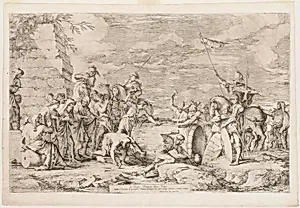
Death of Atilius Regulus
1662
Medium
Etching with drypoint on thick ivory laid paper
Dimensions
Plate: 46.2 × 72.6 cm (18 1/4 × 28 5/8 in.); Sheet: 52.7 × 76.3 cm (20 3/4 × 30 1/16 in.)
Classification
etching
Department
Prints and Drawings
Museum
Art Institute of Chicago
Accession Number
45208
Rights
Public Domain
About this artwork
Salvator Rosa paired this large-scale etching with a similarly oversize print of the crucifixion of Polycrates (the painting is also in the Art Institute collection, 1942.292). He dedicated this etching—depicting the gruesome end of the stalwart Roman consul Atilius Regulus at the hands of the Carthaginians—to his best friend, Giovanni Battista Riccardi, urging him to stay strong in the face of adverse fortune, just as Atilius Regulus “remains a firm center in the midst of so many nails.”
Art Historical Context
Salvator Rosa’s “Death of Atilius Regulus,” created in 1662, captures a dramatic moment from Roman history through the expressive medium of etching with drypoint. The print depicts the legendary consul Marcus Atilius Regulus enduring torture at the hands of his Carthaginian captors, a tale long celebrated for its themes of honor, sacrifice, and stoic resolve. Rosa, a 17th-century Italian artist known for his theatrical compositions and moral intensity, used this large-scale etching—measuring over 18 by 28 inches in the plate—to bring the scene vividly to life for a wide audience. Etching allowed Rosa to combine fine linear detail with rich tonal effects, while drypoint added velvety burr that heightens the emotional tension of the figures. As a work on paper from the Prints and Drawings collection at the Art Institute of Chicago, the piece reflects the Baroque era’s fascination with classical virtue and dramatic narrative, making ancient history accessible through the reproducible art of printmaking. Its impressive size and technical sophistication underscore Rosa’s skill in transforming a moral story into a powerful visual experience for viewers centuries later.
About the Artist
Salvator Rosa · 1615–1673
Salvator Rosa was born in 1615 in Arenella, on the outskirts of Naples, into a world of artistic ambition and turbulent talent. His early training came through his maternal uncle, the painter Paolo Greco, and his brother-in-law Francesco Fracanzano, himself a pupil of the great Spanish-born Neapolitan master Jusepe de Ribera. Rosa showed a fierce independence from the start, resisting his father's...