
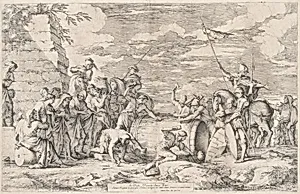
The Death of Atilius Regulus
c. 1662
Medium
etching with drypoint on laid paper
Dimensions
plate: 46.4 × 72.9 cm (18 1/4 × 28 11/16 in.) sheet: 53.4 × 75.7 cm (21 × 29 13/16 in.)
Classification
Department
CG-E
Museum
National Gallery of Art, Washington, D.C.
Credit
Purchased as the Gift of Robert B. Loper
Accession Number
2016.149.1
Rights
Public Domain
Art Historical Context
Salvator Rosa’s etching *The Death of Atilius Regulus*, created around 1662, captures a pivotal moment from Roman history. The scene depicts the legendary consul Marcustilius Regulus, who, after being captured by Carthage during the First Punic War, chose honorable death over betraying Rome. Rosa, an Italian Baroque artist celebrated for his dramatic compositions and philosophical subjects, often explored themes of heroism, sacrifice, and moral fortitude in both paintings and prints. The work’s medium—etching with drypoint on laid paper—allowed Rosa to achieve fine, expressive lines and rich tonal contrasts that heighten the emotional intensity of the narrative. Such prints were widely circulated in the seventeenth century, making complex historical stories accessible beyond elite collectors. Measuring roughly 18 by 29 inches in the plate, the composition balances intricate detail with sweeping movement, inviting viewers to reflect on ancient virtues through a seventeenth-century lens. Housed in the National Gallery of Art, this impression was acquired as a gift and remains a compelling example of Rosa’s skill in translating grand moral tales into the intimate scale of printmaking.
About the Artist
Salvator Rosa · 1615–1673
Salvator Rosa was born in 1615 in Arenella, on the outskirts of Naples, into a world of artistic ambition and turbulent talent. His early training came through his maternal uncle, the painter Paolo Greco, and his brother-in-law Francesco Fracanzano, himself a pupil of the great Spanish-born Neapolitan master Jusepe de Ribera. Rosa showed a fierce independence from the start, resisting his father's...