
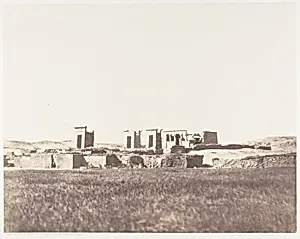
Débôd (Parembole), Vue Générale des Ruines
1851–52, printed 1853–54
Medium
Salted paper print from paper negative
Dimensions
24.1 x 30.7 cm. (9 1/2 x 12 1/16 in.)
Classification
Photographs
Department
Photographs
Museum
Metropolitan Museum of Art, New York, NY
Credit
Purchase, Lila Acheson Wallace Gift, 1976
Accession Number
1976.607.95
Rights
Public Domain
Tags
Art Historical Context
In the mid-19th century, photographer Félix Teynard into Egypt's remote Nubian landscapes during his 1851–52 expedition, capturing ancient wonders with one of photography's earliest processes. *Débôd (Parembole), Vue Gén des Ruines* offers a sweeping vista of weathered architectural remnants at the Débôd site—likely a Ptolemaic temple complex—casing the grandeur and decay of pharaonic heritage. Printed as a salted paper print from paper negative by Imprimer Photographique de H. de Fonteny et Cie around 1853–54, this 24.1 x 30.7 cm image measures about the size of a modern book page, making it intimate yet immersive. The salted paper technique, a hallmark of William Henry Fox Talbot's calotype method, produced soft, textured tones with subtle grain from the paper negative, lending an ethereal quality to the sun-baked stones and vast skies. Teynard's precise composition emphasizes architectural details amid encroaching sands, blending scientific documentation with artistic vision during the dawn of photography. This work holds historical significance as part of Teynard's *Voyage en Égypte et Nubie*, one of the first photographic surveys of Egyptian antiquities. It fueled 19th-century Egyptomania in Europe, preserving views of sites now altered or relocated, like the Temple of Debod in Madrid, for modern eyes. A gem in the Metropolitan Museum of Art's collection, it invites visitors to ponder time's gentle erosion on human ambition.
About the Artist
Félix Teynard|Imprimerie Photographique de H. de Fonteny et Cie · 1817–1892
**Félix Teynard (1817–1892)** was a pioneering French photographer whose work captured the ancient wonders of Egypt and Nubia with unprecedented precision and artistry. Born on January 14, 1817, in Saint-Flour, he trained as a civil engineer in Grenoble, a hub of Egyptology that likely sparked his fascination with ancient architecture. Little is documented about his early life or formal photograph...