
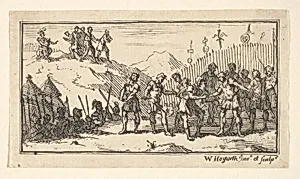
Decimation (John Beaver, Roman Military Punishments, 1725)
after 1725
Medium
Etching
Dimensions
sheet: 1 3/4 x 3 1/16 in. (4.4 x 7.7 cm)
Classification
Prints
Department
Drawings and Prints
Museum
Metropolitan Museum of Art, New York, NY
Credit
Harris Brisbane Dick Fund, 1932
Accession Number
32.35(93)
Rights
Public Domain
Tags
Art Historical Context
"Decimation (John Beaver, Roman Military Pun, 1725)" is a striking etching by William Hogarth created after 1725, measuring just 1 3/4 x 3 1/16 inches. This intimate print captures a grim moment from ancient Roman military history: decimation, a brutal punishment where every tenth soldier in a mutinous legion was executed by their comrades. Likely an illustration for John Beaver's1725 book on Roman military discipline, it depicts soldiers in tense formation, emphasizing the horror of collective accountability. Hogarth, a master of 18th-century British satire and narrative art, employed etching—a precise intaglio technique—to render vivid human figures with emotional depth and dramatic tension. His style, rooted in the Rococo era yet infused with moral commentary, transforms this historical vignette into a poignant reflection on power, obedience, and human suffering. The small scale invites close inspection, revealing Hogarth's skillful line work that conveys both the stoic faces of the condemned and the grim resolve of the executioners. Housed in the Metropolitan Museum of Art's Drawings and Prints department (Harris Brisbane Dick Fund, 1932), this work highlights the enduring fascination with antiquity in Enlightenment-era Britain. It reminds visitors of how art bridges eras, using Roman severity to probe timeless questions of authority and justice.
About the Artist
William Hogarth|John Beaver · 1697–1764
William Hogarth (1697-1764) was an English painter, printmaker, and pictorial satirist who became the first great English-born artist to attract admiration abroad. Born into poverty in London, the son of a failed schoolmaster who was imprisoned for debt, Hogarth's early experiences with the harsh realities of 18th-century urban life profoundly shaped his artistic vision. After apprenticing with si...