
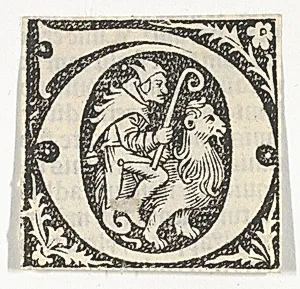
Decorated Roman alphabet
ca. 1499
Medium
Woodcut
Dimensions
Sheet: 1 7/16 × 1 3/8 in. (3.6 × 3.5 cm)
Classification
Prints|Ornament & Architecture
Department
Drawings and Prints
Museum
Metropolitan Museum of Art, New York, NY
Credit
Purchase, Anne and Carl Stern Gift, 1959
Accession Number
59.507.36(13)
Rights
Public Domain
Tags
Art Historical Context
Step into the enchanting world of late 15th-century French printing with this tiny *Decorated Roman Alphabet*, delicate woodcut created around 1499 by an anonymous artist. just 1 7/16 × 1 3/8 inches, this print showcases a single ornate letter from the classical Roman alphabet, embellished with lively motifs of men and lions. Likely part of a pattern book ornamental guide, it captures the era's fascination with intricate decoration, blending human figures and fierce beasts in a whimsical, heraldic style. Woodcut, the medium here, was revolutionary in the 1490s—a technique where artists carved designs into wooden blocks, inked them, and pressed them onto paper. This allowed for affordable reproduction of elaborate designs previously confined to lavish manuscripts. Emerging during France's Gothic-to-Renaissance transition, such prints democratized access to classical Roman forms and fantastical imagery, influencing book illumination, architecture, and decorative arts. Housed in the Metropolitan Museum of Art's Drawings and Prints department (purchased in 1959 with the Anne and Carl Stern Gift), this gem highlights the artistry of anonymity. It reminds us how even minuscule works fueled the visual culture of the printing revolution, bridging medieval fantasy with emerging humanism. A perfect peek into history's decorative playbook!
About the Artist
Anonymous, French, 15th century · 1400–1500
The artist known only as Anonymous, French, 15th century, represents one of the many unidentified creators whose works survive from a transformative era in French art. Active between roughly 1400 and 1500, this figure contributed to the rich tradition of late medieval and early Renaissance painting in France, a period marked by the transition from Gothic conventions toward greater naturalism and h...