
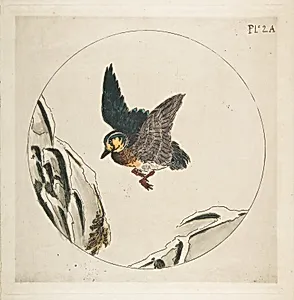
Decoration for a Plate: A Duck flying over Snow-covered Branches
1850–1914
Medium
Etching with watercolor
Dimensions
Sheet: 18 11/16 × 11 7/8 in. (47.5 × 30.2 cm) Plate: 11 5/8 × 11 7/16 in. (29.6 × 29 cm)
Classification
Prints
Department
Drawings and Prints
Museum
Metropolitan Museum of Art, New York, NY
Credit
Rogers Fund, 1922
Accession Number
22.69.25
Rights
Public Domain
Tags
Art Historical Context
Félix Bracquemond's *Decoration for a Plate: Duck Flying over Snow-Covered Branches* (ca. 1850–1914) captures a serene winter moment, with a lone duck soaring gracefully above frost-laden branches. As a leading French etcher of the 19th century Bracquemond was for revitalizing the etching technique during a time when printmaking was fine art and decorative design This piece, intended asation for a plate, the era's fascination with motifs in everyday objects, elegance with naturalism. in etching with watercolor on a substantial sheet (18 11/16 × 11 7/8 in.), the work showcases etching's precision—lines incised into a metal plate for rich, tonal depth—enhanced by delicate hand-applied watercolor for vivid snow whites and subtle plumage hues. Bracquemond's mastery lies in this hybrid medium, which allowed for both reproducibility and artistic flourish, influencing later printmakers and the Japonisme movement's emphasis on refined, asymmetrical compositions. Acquired through the Rogers Fund in 1922 for the Metropolitan Museum of Art's Drawings and Prints department, this print exemplifies 19th-century decorative arts' fusion of utility and beauty. Visitors will appreciate its whimsical duck as a nod to wildlife's quiet poetry amid winter's hush, inviting a closer look at how art graces the table.
About the Artist
Félix Bracquemond · 1833–1914
French, Paris 1833–1914 Sèvres