
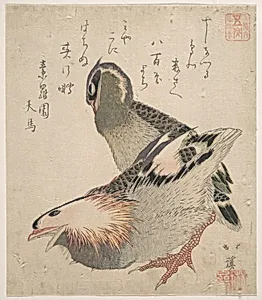
Two Birds
Medium
Woodblock print (surimono); ink and color on paper
Dimensions
8 1/4 x 7 1/8 in. (21 x 18.1 cm)
Classification
Prints
Culture & Period
Japan · Edo period (1615–1868)
Department
Asian Art
Museum
Metropolitan Museum of Art, New York, NY
Credit
H. O. Havemeyer Collection, Bequest of Mrs. H. O. Havemeyer, 1929
Accession Number
JP1871
Rights
Public Domain
Tags
Art Historical Context
**Two Birds** by Totoya Hokkei a delicate woodblock printsurimono) from Edo period (1615–1868), showcasing the artist's mastery in the ukiyo-e tradition. Hokkei, a of the famed Katsushika Hokusai, specialized in these intimate, privately commissioned prints, often created for poetry clubs or New Year's greetings. Measuring just 8¼ x 7⅛ inches, this ink and color on paper work exemplifies the refined scale and elegance of surimono, which were more luxurious than mass-produced ukiyo-e, featuring subtle embossing, mica dusting, and vibrant pigments for a tactile, shimmering effect. Birds, a recurring motif in Japanese art, here evoke the natural world's poetic harmony, possibly alluding to seasonal change or fleeting beauty—core themes of Edo-era aesthetics. Hokkei's precise lines and soft color gradients capture the birds' graceful forms with lifelike poise, blending realism and whimsy. As part of the prestigious H. O. Havemeyer Collection at The Metropolitan Museum of Art, gifted in 1929, it highlights the global fascination with Japanese prints during the 19th-century Japonisme wave. This charming piece invites visitors to appreciate the technical ingenuity of woodblock printing, where carvers and printers collaborated to produce such miniature marvels, bridging art and elite social customs of the time.
About the Artist
Totoya Hokkei · 1780–1850
Totoya Hokkei (魚屋 北渓, 1780–1850), born Iwakubo Tatsuyuki in Edo (modern Tokyo), began his life as a humble fishmonger in the Yotsuya Samegahashi district, a trade reflected in his art name "Totoya," meaning fish shop. He transitioned to art through rigorous training, first studying under Kanō Yōsen'in Korenobu, head of the Kobikichō branch of the prestigious Kanō school, where he honed landscape p...