
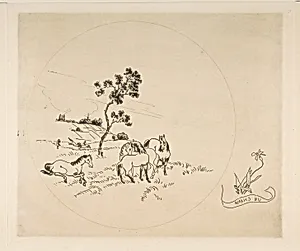
Decoration for a Plate: A Field
Medium
Etching
Dimensions
Sheet: 12 1/8 × 18 5/8 in. (30.8 × 47.3 cm) Plate: 11 3/8 × 13 5/8 in. (28.9 × 34.6 cm)
Classification
Prints
Department
Drawings and Prints
Museum
Metropolitan Museum of Art, New York, NY
Credit
Gift of David Keppel, 1922
Accession Number
22.1.29
Rights
Public Domain
Tags
Art Historical Context
Félix Bracquem's *Decoration for a Plate: Field* (1870) is a delicate etching that captures the pastoral charm of a open field with horses and trees. Housed in the Metropolitan Museum Art's Drawings and Prints, this print—measuring 12 1/8 × 18 5/8 inches on its sheet—was conceived as an ornamental design for ceramic ware, blending fine art with decorative craft. Bracquemond, a masterful French printmaker, created it during a transformative era in European art, amid the Franco-Prussian War, when artists sought beauty in nature's simplicity. Etching, Bracquemond's chosen medium, exemplifies 19th-century technical innovation: a copper plate is coated with a waxy ground, incised with a needle to expose lines, and submerged in acid to "bite" the grooves. Inked and printed under pressure, it yields rich, nuanced textures ideal for evoking the sway of trees and the grace of horses. The plate size (11 3/8 × 13 5/8 inches) suggests precision suited to tableware motifs. This generous gift from David Keppel in 1922 underscores the work's enduring appeal. Bracquemond's etching bridges artistic printmaking and everyday objects, inviting us to appreciate how a humble field scene elevates the ordinary.
About the Artist
Félix Bracquemond · 1833–1914
French, Paris 1833–1914 Sèvres