
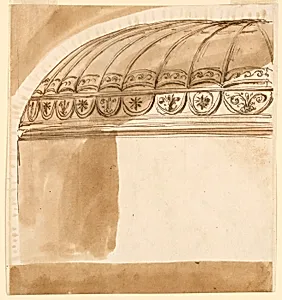
Decoration for low dome of a room
1746–1809
Classification
interiors
Department
Smithsonian Collection
Museum
Smithsonian American Art Museum
Credit
Museum purchase through gift of various donors and from Eleanor G. Hewitt Fund
Accession Number
1938-88-2005
Rights
Public Domain
About this artwork
Research in Progress
Art Historical Context
Giuseppe Barberi (1746–1809), a prominent Italian architect and designer in Rome during the late 18th century created this *Decoration for Low Dome of a Room* a testament to the era's refined approach to interior architecture. Classified within the Smithsonian American Art Museum's collection of interiors, likely represents a preparatory design—perhaps a drawing or plan—for ornamenting the curved ceiling of an intimate domestic space. Barberi's work reflects the transitional period between opulent Rococo flourishes and emerging Neoclassical elegance, where domes served as focal points for intricate decorative schemes. Though the medium remains unidentified amid ongoing research, such designs were essential for nobles and affluent patrons seeking harmonious, illusionistic interiors that drew the eye upward. Low domes, in particular, allowed for innovative patterns that played with light and perspective, enhancing the grandeur of modest rooms. Acquired through museum purchase with support from various donors and the Eleanor G. Hewitt Fund, this piece offers a window into Barberi's contributions to Italian decorative arts. Visitors will appreciate how it captures the craftsmanship of a time when architecture and artistry intertwined seamlessly, inviting us to imagine the vibrant frescoes or stuccowork it once inspired. Ongoing scholarship promises to reveal even more about its context and techniques.