
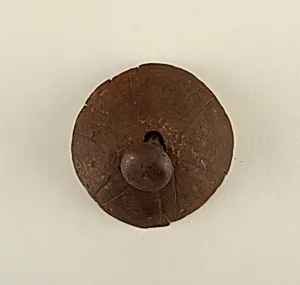
Decorative door boss and nail
15th century
Classification
metalwork
Department
Smithsonian Collection
Museum
Smithsonian American Art Museum
Credit
Gift of Eleanor and Sarah Hewitt
Accession Number
1931-88-5-a,b
Rights
Public Domain
About this artwork
Research in Progress
Art Historical Context
This exquisite *Decorative door boss and nail* from the 15th century the artistry of medieval metalwork, a craft that blended utility with ornamentation. Door bosses—protruding knobs or plates—were commonly affixed to wooden doors in grand European buildings like churches, castles, and town halls. They not only reinforced the structure where nails were driven in but also served as eye-catching embellishments, showcasing the skill of anonymous metalworkers during the late Middle Ages. Crafted in an unknown metal, likely iron, bronze, or brass, this piece highlights techniques such as forging, chasing, or repoussé, which allowed for intricate designs despite the material's challenges. In the 15th century, as Gothic styles evolved toward Renaissance influences, such objects democratized decoration, appearing on both elite and public architecture. Their survival speaks to the durability of metalwork and its role in everyday life turned art. A generous gift from collectors Eleanor and Sarah Hewitt to the Smithsonian American Art Museum, this artifact awaits further research, inviting us to ponder the hands that shaped it amid a transformative era. Visit and imagine the heavy oak door it once adorned!
About the Artist
Unknown
The artist designated as "Unknown" in our virtual museum's collection exemplifies a poignant chapter in art history: creators whose identities have faded into obscurity despite the enduring power of their work. With only one known artwork attributed to them in our holdings, this figure represents countless anonymous hands that shaped visual culture across centuries. Museums worldwide, including th...