
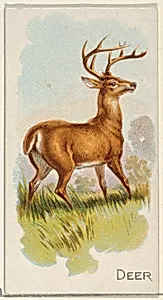
Deer, from the Quadrupeds series (N21) for Allen & Ginter Cigarettes
Medium
Commercial color lithograph
Dimensions
Sheet: 2 3/4 x 1 1/2 in. (7 x 3.8 cm)
Classification
Prints|Ephemera
Department
Drawings and Prints
Museum
Metropolitan Museum of Art, New York, NY
Credit
The Jefferson R. Burdick Collection, Gift of Jefferson R. Burdick
Accession Number
63.350.201.21.12
Rights
Public Domain
Tags
Art Historical Context
Step into the vibrant world of 19th-century advertising with *Deer, from the Quadrupeds (N21)*, a delightful chromolithograph produced by Allen & Ginter in 1890. This tiny gem, measuring just 2 3/4 x 1 1/2 inches, was one of many collectible cards inserted into cigarette packs to entice smokers and spark a collecting craze. Allen & Ginter, innovative tobacco pioneers, partnered with lithographers Lindner, Eddy & Claus create these ephemera, capturing the grace of a deer in exquisite detail against a natural backdrop. The medium—commercial color lithography—revolutionized mass printing, allowing vivid hues and fine lines to bring wildlife to life affordably. Part of the Quadrupeds series, it reflects the era's fascination with nature and exotic animals, blending education with commerce in an age before digital media. These cards weren't just throwaways; they fueled a burgeoning hobby culture, preserving moments of artistry amid everyday indulgence. Today, housed in the Metropolitan Museum of Art's Drawings and Prints department as part of The Jefferson R. Burdick Collection, this piece highlights ephemera's enduring value. Burdick's generous gift immortalizes these mini-masterpieces, reminding us how advertising once doubled as accessible art. Spot the deer's alert poise— a snapshot of Gilded Age whimsy!
About the Artist
Allen & Ginter|Lindner, Eddy & Claus
Allen & Ginter, the pioneering American tobacco firm based in Richmond, Virginia, emerged around 1880 from the partnership of John F. Allen and Lewis Ginter, evolving from Allen's earlier John F. Allen & Company. Allen retired in 1882, succeeded by John Pope, yet the brand endured under Ginter's leadership, employing over 1,100 workers—mostly women—for hand-rolled cigarettes by 1886. Ginter, a Dut...