
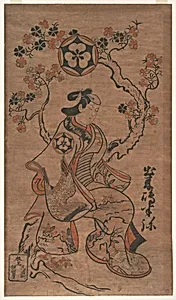
Dekishima Hanya Seated on a Cherry Tree
ca. 1700–05
Medium
Woodblock print; ink and color on paper
Dimensions
22 x 12 3/4 in. (55.9 x 32.4 cm)
Classification
Prints
Culture & Period
Japan · Edo period (1615–1868)
Department
Asian Art
Museum
Metropolitan Museum of Art, New York, NY
Credit
The Francis Lathrop Collection, Purchase, Frederick C. Hewitt Fund, 1911
Accession Number
JP649
Rights
Public Domain
Tags
Art Historical Context
Torii Kiyonobu I's *Dekishima Hanyaated on a Cherry Tree* (ca. 1700–05) is a vibrant woodblock print from Japan's Edo period (1615–1868), capturing theant world of kabuki theater. As a leading figure in the Torii school, Kiyonobu pioneered *yakusha-e*— portraits that brought the drama of the stage to everyday viewers. This print likely depicts the actor Dekishima in the role of Hanya, a fierce demoness from Noh and kabuki traditions, perched dramatically amid blooming cherry branches, symbolizing ephemeral beauty in Japanese culture. Crafted with ink and color on paper, the work showcases early ukiyo-e techniques: bold outlines, flat color blocks, and dynamic composition achieved through meticulous woodblock carving and printing. At 22 x 12 3/4 inches, its vertical format emphasizes the actor's expressive pose and the delicate cherry blossoms, blending theatrical intensity with natural poetry. These prints were affordable and widely circulated, fueling Edo Japan's entertainment craze. Housed in the Metropolitan Museum of Art's Asian Art collection, this piece highlights the Torii school's foundational role in ukiyo-e, influencing masters like Hiroshige and Hokusai. Visitors will appreciate how it immortalizes kabuki's larger-than-life stars against fleeting sakura, a timeless nod to life's pleasures.
About the Artist
Torii Kiyonobu I · 1664–1729
Torii Kiyonobu I (1664–1729), born Shōbei in Osaka, was the second son of Torii Kiyomoto, a prominent kabuki actor specializing in onnagata roles and a painter of theater signboards. He studied painting under his father as well as Yoshida Hanbei and Hishikawa Moronobu, the pioneering ukiyo-e master whose figure styles profoundly shaped his early work. In 1687, at age twenty-four, Kiyonobu accompan...