
Demain sera beau, disait le naufrage
1922
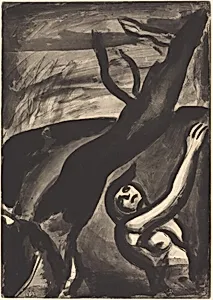
Medium
aquatint, roulette, and drypoint over heliogravure
Classification
Portfolio
Department
CG-W
Museum
National Gallery of Art, Washington, D.C.
Credit
Rosenwald Collection
Accession Number
1950.1.152
Rights
Public Domain
Art Historical Context
Georges Rouault's *Demain sera beau, disait le naufrage* (2), translating to "Tomorrow will be, said the shipwreck captures the artist's poignant blend of irony and pathos. A leading figure in early 20th-century French Expressionism, Rouault from Fauvism's colors and forms but infused his work with a mystical, religious intensity, often evoking stained-glass windows through heavy black outlines and vivid contrasts. Created amid Europe's post-World War I recovery, this print reflects the era's lingering despair, using the shipwreck metaphor to question hollow optimism in the face of human tragedy. The medium—aquatint, roulette, and drypoint over heliogravure—showcases Rouault's innovative printmaking. Heliogravure provided a photomechanical base for tonal depth, while the artist's hand-applied intaglio techniques added gritty textures (roulette's wheel-like burrs), soft tonal washes (aquatint), and expressive lines (drypoint). This labor-intensive layering elevated mass-produced elements into deeply personal expressions, a hallmark of Rouault's oeuvre. Housed in the National Gallery of Art's Rosenwald Collection (Department CG-W, Portfolio classification), this work exemplifies Rouault's critique of modernity's illusions. Visitors will appreciate its emotional resonance, bridging technical mastery with timeless themes of hope and ruin.
About the Artist
Georges Rouault · 1871–1958
Georges-Henri Rouault was born on May 27, 1871, in a Paris cellar during the violent "Bloody Week" of the Paris Commune, when a stray shell destroyed his family's home in the working-class Belleville district. Raised by a carpenter father who worked at the Pleyel piano factory and a grandfather who collected prints by Honoré Daumier, Rembrandt, Courbet, and Manet, Rouault showed early artistic pro...