
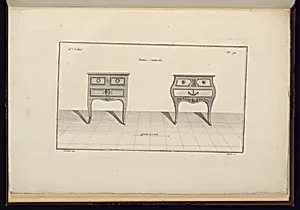
Demies Commodes
Medium
Classification
Department
Smithsonian Collection
Museum
Smithsonian American Art Museum
Credit
Purchased for the Museum by the Advisory Council
Accession Number
1921-6-252-86
Rights
Public Domain
About this artwork
Research in Progress
Art Historical Context
Juste-François Boucher’s print *Demies Commodes*, created around 1775 offers a glimpse into the refined world of late eighteenth-century French decorative design. As the son of the celebrated Rococo painter François Boucher, the younger artist worked primarily as an engraver and draftsman, producing works that captured the elegance of contemporary furnishings. This print, held in the Smithsonian American Art Museum’s collection, likely served as a design record or pattern for furniture makers during a period when French taste was shifting from exuberant Rococo curves toward the more restrained lines of Neoclassicism. Prints like this one played an essential role in spreading artistic ideas across Europe and beyond. Before photography, engravings allowed cabinetmakers, patrons, and collectors to study and replicate fashionable forms such as the half-commodes suggested by the title. Purchased for the museum by its Advisory Council, the work now invites visitors to consider how such images helped shape domestic interiors and the international reputation of French craftsmanship in the years leading up to the Revolution.