
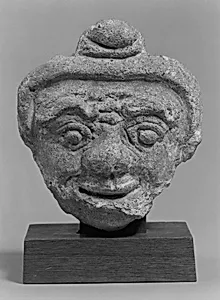
Demonic Head
Unknown Artist
9th century
Medium
Stucco
Dimensions
H. 6 1/2 in. (16.5 cm); W. 5 11/16 in. (14.4 cm); D. 4 1/4 in. (10.8 cm)
Classification
Sculpture
Culture
Thailand
Department
Asian Art
Museum
Metropolitan Museum of Art, New York, NY
Credit
Gift of Mr. and Mrs. Roger Stoll, 1984
Accession Number
1984.494.1
Rights
Public Domain
Tags
Art Historical Context
This striking stucco sculpture, simply titled *Demonic Head*, originates from ninth-century Thailand and exemplifies the vibrant tradition of Southeast Asian temple art. Created by an unknown artist, the piece captures the fierce visage of a demon with exaggerated features—likely intended as a guardian figure to ward off evil spirits from sacred spaces. Its compact scale suggests it once adorned the exterior of a temple or shrine, where such heads played protective roles in Hindu-Buddhist cosmology. Stucco, a versatile lime-based plaster, was prized in ancient Thailand for its ability to be molded into expressive forms while withstanding tropical climates. Artisans applied layers over brick or stone cores, allowing for dynamic modeling of horns, fangs, and bulging eyes that convey both menace and vitality. This medium’s widespread use highlights the region’s sophisticated architectural decoration during a period of flourishing religious patronage. Acquired by the Metropolitan Museum of Art in 1984 as a gift from Mr. and Mrs. Roger Stoll, the work offers visitors a tangible connection to Thailand’s early sculptural heritage. Its presence in the Asian Art collection underscores the enduring power of mythological imagery in shaping cultural identity.