
Denarius (Coin) Depicting the Dioscuri
49 BCE
Medium
Silver
Dimensions
Diam.: 1.8 cm (3/4 in.)
Classification
coin
Department
Arts of Greece, Rome, and Byzantium
Museum
Art Institute of Chicago
Accession Number
141610
Rights
Public Domain
About this artwork
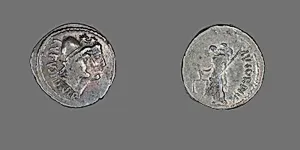
The front (obverse) of this coin depicts the mythical twins known as the Dioscuri in profile. One has short hair held in place by a rope or laurel wreath while the other wears two stars in his hair. On the back (reverse), an unidentified robed figure stands facing left, head bowed while holding a scale in one hand and a sceptre in the other. The smaller figure shown behind is likely that of Cupid.
Art Historical Context
Step into the vibrant world of ancient Rome with this silver denarius, coin just 1.8 cm in diameter, minted in 49 BCE. Housed in the Art Institute of Chicago's Department Arts of Greece, Rome and Byzantium, it depicts the Dioscuri— the twin gods Castor Pollux— revered as protectors of Rome and symbols of cavalry prowess. These divine brothers, often shown on horseback with starry caps, appear here in high relief, capturing the essence of Roman mythological devotion on everyday currency. Crafted during the turbulent Roman Republic era, specifically the year Julius Caesar crossed the Rubicon sparking civil war, this denarius exemplifies how coins doubled as propaganda tools. The silver medium, valued for its durability and shine, allowed for intricate die-struck designs that conveyed imperial or military legitimacy to soldiers, merchants, and citizens alike. Roman numismatic artistry shines in its precision: engravers used hardened iron dies to strike the flan, producing sharp details on both obverse and reverse despite the coin's modest size. This piece not only facilitated trade but immortalized cultural heroes, reminding us of Rome's blend of piety, power, and portability in art.
About the Artist
Ancient Roman
The artists attributed to "Ancient Roman" in museum collections represent the anonymous craftsmen who produced the vast output of sculpture, frescoes, mosaics, and reliefs defining Roman visual culture from the Republic (c. 509–27 BCE) to the late Empire (c. 395 CE). Individual identities remain elusive, as Roman makers were typically viewed as skilled tradesmen—often enslaved Greeks or provincial...