
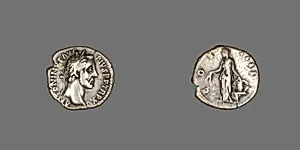
Denarius (Coin) Portraying Emperor Antoninus Pius
Medium
Silver
Dimensions
Diam.: 1.9 cm (3/4 in.)
Classification
coin
Department
Arts of Greece, Rome, and Byzantium
Museum
Art Institute of Chicago
Accession Number
10027
Rights
Public Domain
About this artwork
The front (obverse) of this coin portrays the emperor Antoninus Pius, wearing a crown of laurels and facing right. On the back (reverse), the goddess Annona- the divine personification of the grain supply to the city of Rome- is depicted standing and holding ears of corn.
Art Historical Context
This exquisite silver denarius, minted in 152 AD during the reign of Emperor Antoninus Pius, captures the serene visage of one of Rome's most benevolent rulers. Measuring just 1.9 cm in diameter this tiny artifact from the Art Institute of Chicago Arts of Greece, Rome and Byzantium collection exemplifies the precision of Roman imperial coinage. Antoninus Pius (r. 138–161 AD), adopted successor to Hadrian, is depicted in profile—likely laureate-headed—symbolizing his piety and stability in an era of relative peace known as the Pax Romana. As the standard silver currency of the empire, the denarius facilitated trade across vast territories while serving as potent propaganda. Struck from high-purity silver, it bore the emperor's portrait on the obverse to foster loyalty and divine authority, with the reverse often featuring deities, victories, or imperial motifs. Artisans used engraved dies to produce these coins en masse, achieving remarkable detail in hair, drapery, and inscriptions despite the small scale—a testament to Roman minting mastery. Today, such coins offer a window into daily Roman life, economy, and imperial ideology, blending artistry with political messaging in a format accessible to all citizens. Held in your palm, it evokes the enduring legacy of an emperor whose just rule earned him the epithet "Pius."
About the Artist
Ancient Roman
The artists attributed to "Ancient Roman" in museum collections represent the anonymous craftsmen who produced the vast output of sculpture, frescoes, mosaics, and reliefs defining Roman visual culture from the Republic (c. 509–27 BCE) to the late Empire (c. 395 CE). Individual identities remain elusive, as Roman makers were typically viewed as skilled tradesmen—often enslaved Greeks or provincial...