
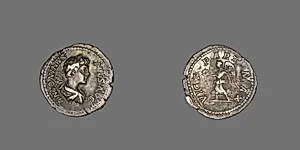
Denarius (Coin) Portraying Emperor Caracalla
201-206
Medium
Silver
Dimensions
Diam.: 2 cm (13/16 in.)
Classification
coin
Department
Arts of Greece, Rome, and Byzantium
Museum
Art Institute of Chicago
Accession Number
10044
Rights
Public Domain
About this artwork
The front of this coin portrays the emperor Caracalla, facing right. On the back, the goddess Victory is depicted holding a wreath.
Art Historical Context
Step into the world of Rome with this exquisite silverarius, struck between 201 and CE, portraying the young Emperoracalla. Measuring just 2 cm diameter, this tiny treasure the Severan dynasty captures Caracalla—then Caesar Marcus Aurelius Antoninus—likely in a classic laureate portrait on the obverse, a hallmark of imperial coinage Minted during the reign of his father, Septimius Severus, it exemplifies the Roman Empire's mastery of numismatic art. Denarii like this were more than currency; they were tools of propaganda disseminating the emperor's image across the vast empire from Britain to Egypt. Caracalla's early coins reflect the turbulent transition from the Antonine era to the militaristic Severans, foreshadowing his own ruthless rule after 211 CE. The silver medium, alloyed for durability, allowed for intricate details achieved through die-striking techniques—hammering a blank flan between engraved obverse and reverse dies—producing high-relief portraits that rival sculpture in realism. Housed in the Art Institute of Chicago's Department of Arts of Greece, Rome, and Byzantium, this coin offers a tangible link to daily Roman life, trade, and power. It reminds us how art permeated even the smallest objects, blending artistry with authority in an era of empire-building.
About the Artist
Ancient Roman
The artists attributed to "Ancient Roman" in museum collections represent the anonymous craftsmen who produced the vast output of sculpture, frescoes, mosaics, and reliefs defining Roman visual culture from the Republic (c. 509–27 BCE) to the late Empire (c. 395 CE). Individual identities remain elusive, as Roman makers were typically viewed as skilled tradesmen—often enslaved Greeks or provincial...