
Denarius (Coin) Portraying Emperor Domitian
88-89
Medium
Silver
Dimensions
Diam.: 1.8 cm (3/4 in.)
Classification
coin
Department
Arts of Greece, Rome, and Byzantium
Museum
Art Institute of Chicago
Accession Number
141824
Rights
Public Domain
About this artwork
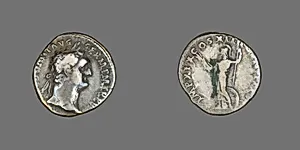
The front (obverse) of this coin portrays the head of Emperor Domitian, facing right. The back (reverse) depicts Pallas standing to the left and holding a spear, with a shield at her feet.
Art Historical Context
This exquisite silver denarius, minted around 88-89 CE during the reign of Emperor Domitian, offers a glimpse into the power and propaganda of ancient Rome. Measuring just 1.8 cm in diameter, this coin from the Art Institute of Chicago's Arts of Greece, Rome, and Byzantium collection features a detailed portrait of Domitian on the obverse, a common imperial practice to symbolize the ruler's divine authority and presence across the vast empire. Domitian, who ruled from 81 to 96 CE, used such coinage to broadcast his military victories and architectural achievements, like the restoration of the Flavian Amphitheater (Colosseum). As a standard unit of Roman currency, the denarius held immense economic and cultural weight, equivalent to a day's wage for a laborer. Struck with precision using dies hammered onto heated silver planchets, these coins showcased advanced minting techniques that allowed for intricate laurel-wreathed portraits and symbolic reverses—often depicting deities, triumphs, or imperial virtues. Though Domitian's autocratic rule ended in assassination, his denarii endure as artifacts of Flavian artistry and statecraft. Visitors will appreciate how this tiny treasure encapsulates Rome's blend of artistry and politics, reminding us that even money was a canvas for empire-building.
About the Artist
Ancient Roman
The artists attributed to "Ancient Roman" in museum collections represent the anonymous craftsmen who produced the vast output of sculpture, frescoes, mosaics, and reliefs defining Roman visual culture from the Republic (c. 509–27 BCE) to the late Empire (c. 395 CE). Individual identities remain elusive, as Roman makers were typically viewed as skilled tradesmen—often enslaved Greeks or provincial...