
Denarius (Coin) Portraying Emperor Elagabalus
218-222
Medium
Silver
Dimensions
Diam.: 1.9 cm (3/4 in.)
Classification
coin
Department
Arts of Greece, Rome, and Byzantium
Museum
Art Institute of Chicago
Accession Number
142611
Rights
Public Domain
About this artwork
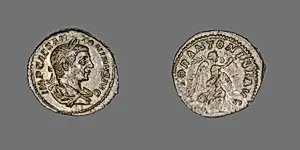
The front (obverse) of this coin portrays the bust of Emperor Antoninus Pius, laurate and facing right. The back (reverse) depicts Victory striding to the right with a wreath and palm.
Art Historical Context
This exquisite silver denarius, minted during the brief and tumultuous reign of Emperor Elagabalus (r. 218–222 CE), captures the youthful profile of one of Rome's most controversial rulers. At just 1.9 cm in diameter this coin exemplifies the precision of Roman imperial minting, where the emperor's likeness—often shown laureate and draped—served as powerful propaganda. Elagabalus, a teenage Syrian priest elevated to the throne amid civil war, scandalized Rome by promoting the sun god Elagabal over traditional deities, making his coins a snapshot of cultural upheaval in the Severan dynasty. Crafted through striking metal between engraved dies, the denarius combined artistry with utility as everyday currency across the vast empire. Its high-relief portraiture reflects the realistic style of late Roman coinage, evolving from Greek influences toward individualized imperial imagery that reinforced authority and divinity. Silver's purity ensured economic trust, while intricate reverses (likely depicting victories or gods) amplified political messages. Housed in the Art Institute of Chicago's Arts of Greece, Rome, and Byzantium department, this coin invites visitors to ponder how tiny artifacts wielded immense power, bridging art, economics, and empire in ancient Rome.
About the Artist
Ancient Roman
The artists attributed to "Ancient Roman" in museum collections represent the anonymous craftsmen who produced the vast output of sculpture, frescoes, mosaics, and reliefs defining Roman visual culture from the Republic (c. 509–27 BCE) to the late Empire (c. 395 CE). Individual identities remain elusive, as Roman makers were typically viewed as skilled tradesmen—often enslaved Greeks or provincial...